
Panel discussion 'Macro & Asset Class Outlook for 2026 and beyond'
This report was originally written in Dutch. This is an English translation.
Which region has the best investment prospects? Are there any advantages for Europe in the protectionist policies of US President Trump? And how concerned should investors be about rising inflation?
By Michiel Pekelharing
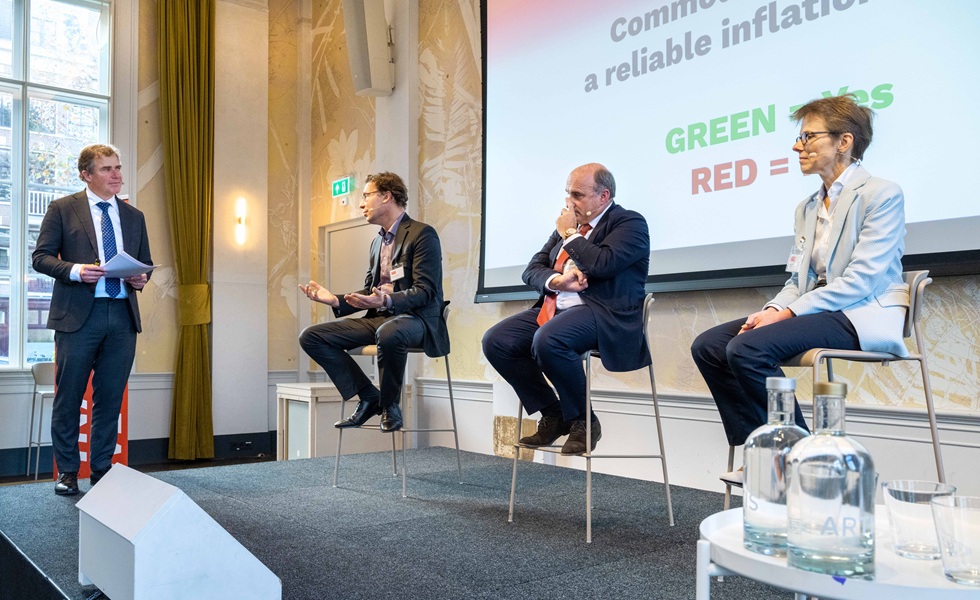
During Financial Investigator's Outlook seminar, these and other questions were addressed in a panel discussion on macroeconomics and asset classes, chaired by Olaf van den Heuvel.
|
CHAIR Olaf van den Heuvel, CIO, Achmea Investment Management
PARTICIPANTS Charles Kalshoven, Expert Beleggingsstrateeg, APG Asset Management Frédéric Leroux, Hoofd Cross Asset Team, Carmignac Ineke Valke, Senior Beleggingsstrateeg, Wealth Management Partners |
According to Ineke Valke, Senior Investment Strategist at Wealth Management Partners, inflation prospects are strongly region-specific: ‘Inflation is likely to remain stubbornly higher in the US than in Europe. This is partly due to the impact of new tariffs, the weak dollar and fiscal measures, which are driving up prices. In Europe, the picture is more mixed. Deglobalisation and government investment are creating upward pressure. At the same time, the stronger euro, increased competition and Chinese dumping are pushing prices down. Ultimately, I expect moderate inflation and limited growth in Europe, partly due to cost savings and tax cuts.’ Valke points out that the impact of US trade tariffs is not yet fully reflected in the figures. ‘The impact has been delayed. Due to political uncertainty and the fact that the Trump administration has not implemented all measures immediately, the real effects will not be visible until 2026.’
According to Frédéric Leroux, Head of the Cross Asset team at Carmignac, a fundamental shift is taking place in terms of inflation: ‘We have entered a new era of structurally higher inflation. The globalisation that tempered inflation for decades is over. Deglobalisation, demographic trends, geopolitical tensions and social pressures are leading to permanently higher prices.’ According to Leroux, the era of ‘low inflation and low interest rates’ is definitively over: ‘Trump wants to weaken the dollar. He is putting pressure on the Federal Reserve to lower its policy rate and is implementing tax cuts. All of this is inflationary. Even if technological innovation destroys jobs, it will happen too slowly to offset upward price pressure.’
Charles Kalshoven, Expert Investment Strategist at APG Asset Management, also sees that structural inflation risks have increased. He focuses primarily on European inflation, which he believes is likely to average slightly above the ECB's 2% target in the longer term. ‘The world has become less predictable. Deglobalisation and geopolitical surprises, among other things, are increasing the risk of inflation shocks. As a result, average inflation will be higher than the ECB's 2% target. That target will undoubtedly remain the same, but the ECB will not compensate for overshooting with undershooting. For example, after two years of 4% inflation – which is a cumulative 4% too much – the ECB will not aim for 1% inflation for four years to make up for this. For this reason, average inflation in the long term is more likely to be between 2.25% and 2.5%. The years in which inflation did not sustainably reach 2% – between the GFC and Covid – are truly behind us.
Commodities are somewhat inconspicuous friends: they are not the life and soul of the party, but they are pillars of support in times of need.
Diversification: away from the US?
Chair Olaf van den Heuvel raises the question of whether it is wise, with the prospect of somewhat higher inflation, to switch to an investment policy that no longer focuses on the US. The audience largely agrees, but the panellists see some nuance.
‘I would never completely exit the US, of course,’ says Valke. ‘The profitability of American companies remains impressive. Their innovative strength – certainly in the field of AI – creates structural opportunities. Everyone has been saying for months that you should exit the US, but the market remains strong. Instead of ignoring American equities, I believe you could slightly underweight them in your portfolio.’
Kalshoven emphasises that higher inflation should not be a reason to review the regional diversification of the portfolio. One reason is that equities are in fact real assets. Instead, a better approach is to hedge dollar exposure, because higher inflation ultimately translates into a weaker currency. Kalshoven: ‘Many institutional investors have increased their dollar hedging this year. That seems more sensible to me than a geographical rotation purely because of inflation.’
Leroux does expect somewhat higher inflation to be felt in the investment world through rising interest rates. ‘That is bad news for growth stocks. The entire pro-US trade of the past decade will be unwound in such a scenario. Investors will take profits on US tech stocks and switch to value stocks in Europe, Japan and emerging markets. That is a fundamental rotation. So away from the US, towards cyclical and value-driven markets.’
The prospect of higher inflation making itself felt in the investment world raises the question for Van den Heuvel of whether commodities and gold will remain a reliable hedge against inflation. ‘Yes,’ says Leroux without hesitation. ‘Inflation and economic growth will go hand in hand in the coming years. For years, governments have been trying to reduce the ratio between GDP and public debt by cutting public debt. That has not worked, so now they are focusing on high nominal growth. This is creating enormous demand for commodities. AI is also driving up demand for energy and metals such as copper. Commodities are a logical hedge, but many investors have deprived themselves of that option due to ESG criteria or reputational risks. As a result, allocation to commodities will remain low, even though they are needed.’
The profitability of American companies remains impressive. Their innovative strength – certainly in the field of AI – creates structural opportunities.
Kalshoven does make one comment on this: ‘Commodities are somewhat inconspicuous friends: they are not the life and soul of the party, but they are pillars of support in times of need. Average long-term returns are not spectacular, but they perform well during inflationary shocks. They function as insurance. You hope you won't need them, but in times of stress they prove their worth.’
The discussion on commodities raises the question in the room of whether gold deserves a place in the investment portfolio. Its value has risen significantly in recent years. Leroux: 'There are two factors behind the gold rally. Central banks are diversifying away from the dollar, and real interest rates remain low or negative. That is a perfect climate for gold. In the short term, it may correct, but structurally it remains interesting.’ Kalshoven largely agrees: ‘For investors with a 60/40 portfolio, gold can be a valuable stabiliser, especially when interest rates and stock markets are under pressure at the same time.’
Where are the opportunities?
After discussing inflation and commodities, Van den Heuvel shifts the conversation to the question of where opportunities lie for investors in this changing macro climate. Valke looks at specific market segments: 'We see a lot of potential in Japan, China, small caps and private assets. In Japan, there is finally a generation of business leaders who are willing to reform. Corporate governance is being tightened up and profitability is improving structurally. The new prime minister is accelerating these developments, which are favourable for investors. The yen is a risk factor, but the structural picture is positive. A little further west, a turnaround is also taking shape in China. Companies there are now allowed to pursue profit maximisation. Moreover, the government is stimulating domestic demand. Low valuations make it attractive to invest there now. Another interesting segment is small caps, which have some catching up to do. These shares have long lagged behind large caps, but will soon benefit from lower short-term interest rates, rising takeovers and more attractive valuations.
Leroux agrees: ‘Small caps are indeed undervalued. I also have two additional ideas for investors. The first is to buy inflation swaps. The market is pricing in an average inflation rate of 2.5% for the next ten years in the US. That is too low, and inflation swaps are a much smarter way to benefit from this than inflation-linked bonds. It is also interesting to look at energy now. Investors currently have very small positions in commodity and energy sectors, just as they did in China just before that market recovered. Trump's policies will strengthen cooperation between Russia, China and India, which will drive growth in those regions. That could drive up energy prices.’
We have entered a new era of structurally higher inflation. The globalisation that tempered inflation for decades is over.
Kalshoven does not mention any specific investment opportunities, but he does see an excellent opportunity for Europe: ‘Trump is making the US less attractive to top talent with, among other things, a strict immigration policy and attacks on universities. This offers Europe the opportunity to attract scientists and innovators. That may sound indirect, but it is a competitive advantage in the long term. Knowledge networks could shift towards Europe if we approach this in a smart way.’
Bonds and active versus passive
The audience asks whether investors should be concerned about the quality of European government bonds, now that governments want to invest more and expand their budgets. When positioning himself in the fixed-income market, Valke mainly looks at the average remaining maturity: ‘We have lower interest rate sensitivity in the portfolio because we expect interest rates to rise. Within the bond markets, we see opportunities mainly in investment grade bonds and global high-yield loans. The fundamentals are strong, and there is still sufficient buffer to absorb any defaults.’ Leroux warns that the risk of inflation is being underestimated: ‘The market is not pricing in enough inflation. That is a danger. Anyone who relies solely on government bonds now is running an asymmetric risk. We prefer shorter durations and instruments that benefit directly from higher inflation.
Finally, Van den Heuvel asks whether now is the time to return to active investing, rather than passively tracking an index. Valke is inclined to think so. ‘We are late in the cycle, and the differences between regions and sectors are increasing. A slightly more active selection is therefore worthwhile. At the same time, cost efficiency remains important, so a mixed approach makes sense.’ Kalshoven does not venture to time the market cycle: ‘There is a place for active investing, but that lies more in fundamental analysis than in timing. The starting point for a long-term investor is primarily the market portfolio. Deviating from this only makes sense if you are truly convinced. Concentration in AI shares is a risk, but who says it won't continue for years to come? It's difficult to pick the winners.’ However, according to Leroux, this is not a decisive argument for choosing index solutions: ‘I am more of a macro man than a stock picker. But I see that investors have become complacent due to the years of outperformance of passive strategies. In a world with more volatility and inflation, active management is making a comeback.’
|
SUMMARY Inflation remains higher and more volatile due to deglobalisation, geopolitical tensions and US policy. The US remains important, but a slight underweighting is logical. Dollar hedging is more relevant than regional rotation. Commodities and gold offer lasting protection against inflation shocks. Opportunities lie in Japan, China, small caps, energy and inflation swaps, among others. Europe can benefit from US protectionism by attracting talent and innovation. Active management gains value in a more volatile climate. |