
Harry Geels: Capital (gains) tax is a fiscal chimera

This column was originally written in Dutch. This is an English translation.
By Harry Geels
Last week, the House of Representatives once again discussed a capital gains tax. The current proposal is a fiscal chimera for five reasons. For example, equity investors will soon face a significant and real risk that their capital gains will be completely taxed away.
Anyone who followed the recent debate in the House of Representatives about box 3 saw not so much a legislative process as politicians who were unsure what to do with the proposal. As EW Magazine describes it, the debate on the Real Return Act mainly revolved around one explosive issue: should unrealised (“paper”) gains also be taxed annually at a rate of 36%? Many parties are opposed or openly confused. And rightly so.
The State Secretary continued to emphasise that urgent action is needed due to billions in losses/revenues that have already been booked. However, there is still no clear, coherent answer to essential questions – liquidity, feasibility, loss relief and the distinction between shares and real estate. The result we now have is a fiscal chimera: a system built on separate, conflicting arguments that disrupts market forces and practically invites evasive behaviour (a chimera is a mythical creature consisting of different animals).
Five classic arguments against wealth tax
If there is one tax against which many arguments can be made, it is wealth (growth) tax. From an economic and philosophical point of view, such a tax does not fit into a capitalist system in which property is sacred. Incidentally, it does fit perfectly into our current socialist system. Furthermore, a wealth (gains) tax taxes inflation. By investing, investors hope to compensate for inflation caused by monetary and fiscal policy. Taxation frustrates this.
In addition, the risk-return ratio of investing is affected, especially if one type of capital is treated differently from another for tax purposes. For example, if savings are not taxed, but shares are, the legislation is no longer neutral, which means that optimal capital allocation does not take place in the economy. Furthermore, every tax incurs implementation and avoidance costs. The cost-benefit analysis of capital (gains) tax is negative, mainly because the tax is complicated.
Current proposal too complex and excessive
The plan for capital (gains) tax as it currently stands is downright complex and excessively burdensome. For example, for certain investment categories, tax must be paid annually on the profit, even if that profit has not yet been realised (as is the case with shares), while the profit on real estate only has to be paid when it is realised upon sale. The argument used for this distinction is liquidity: shares are said to be easy to sell in order to pay the capital gains tax.
This “liquidity argument” is downright ludicrous. Private equity, for example, is subject to annual taxation, even though it is also illiquid. Moreover, the legislator presents share investors with timing problems: when should which part of the shares be sold? Property investors are also faced with timing problems when it comes to settlement. It cannot be ruled out that property investors will optimise their sales moments for tax purposes. The bill contains tough market interventions, with side effects.
Taxes that are far too high
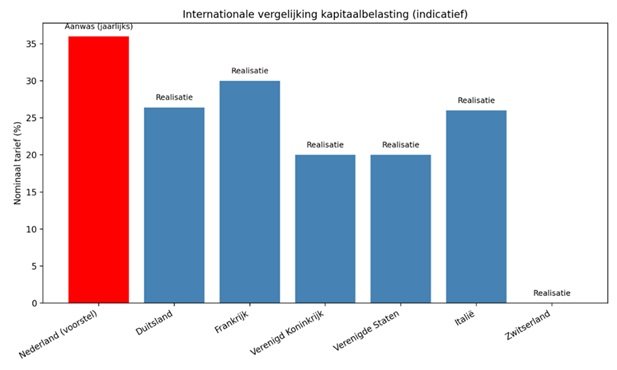
In addition, the 36% rate on capital gains is high by international standards. Most countries levy tax on realised profits. Although this is not ideal either, given the arguments mentioned above, the taxes on those realised returns are lower. The Dutch proposal is therefore exceptionally expensive, complex and experimental by international standards. Various countries, including Switzerland, keep it simple: they do not tax capital gains or do so in a simpler manner.
Figure 1
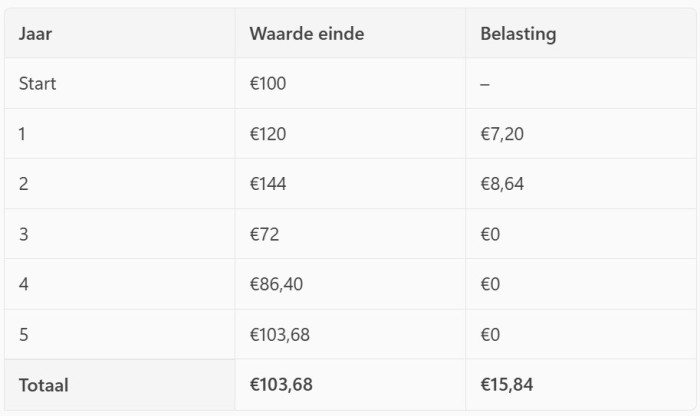
Moreover, the taxes for equity investors in the current proposal could turn out to be extreme. Suppose we invest €100 for five years with the following returns: year 1: 20%, year 2: 20%, year 3: -50%, year 4: 20% and year 5: 20%. Figure 2 shows that, without tax, we would have earned €3.68 and paid €15.84 in tax, i.e. a tax of 430% on the profit. This legislation was devised by people with no knowledge of financial arithmetic and, in particular, of the so-called “volatility drain”.
Figure 2
A better solution
As argued earlier, it is better to tax the fruits of capital. Firstly, this is in line with the way we tax other factors of production. For example, income from labour is taxed with income tax and the fruits of entrepreneurship with profit tax. Income from capital, such as dividends and rent, can be taxed in a similar way. The advantages of this are that this tax can be collected efficiently through withholding tax and that it concerns actual, liquid income.
There are three side discussions regarding my proposal. Firstly, it initially generates less tax revenue. As far as I am concerned, that is fine. The tax burden is already high and if money is needed, we can also cut back on spending. Secondly, my proposal does not address the size and distribution of wealth – i.e. the alleged wealth inequality. However, wealth inequality in the Netherlands is not that great, and we would do better to tackle the causes of wealth inequality than to treat the symptoms with taxation.
A third comment is that tax avoidance can also occur when taxing the returns on wealth. For example, companies can issue zero-coupon bonds or not distribute profits in the form of dividends, but use them to buy back shares or hold them in some other way. However, relatively simple solutions can be found for this, such as taxing share buybacks or taxing the implicit interest on zero coupons.
Conclusion
The fact that the debate on box 3 is chaotic is no coincidence and no failure of communication, but a logical consequence of fundamentally flawed assumptions. A capital gains tax that taxes realised and unrealised returns indiscriminately, treats different asset categories unequally and ignores the basic workings of return and risk is bound to go off the rails. The more this system is repaired, the more complicated it will become.
The fiscal chimera currently on the table is not the result of too little time, but of too little economic consistency and a lack of knowledge of how financial markets work (mathematically). Anyone who truly wants simplicity, fairness and efficiency will have to accept that not every ideological desire can be incorporated into tax legislation and that it is sometimes wiser to tax what is actually enjoyed than to pursue fairness on paper that does not work in practice.
This article contains the personal opinion of Harry Geels