
GSAM: Quantitative precision - unlocking Europe’s alpha potential

Europe’s diversity, fragmentation, and slower price discovery enable abundant yet elusive alpha potential. Quantitative strategies can systematically capitalize on these market inefficiencies, turning complexity into consistent, scalable outperformance.
By Hania Schmidt, Global Co-Head of Client Portfolio Management, Quantitative Investment Strategies, Goldman Sachs Asset Management
Europe’s equity markets are a compelling, often overlooked source of alpha. Their diversity, fragmentation, and lower informational coverage create inefficiencies, from complex stock relationships to slower price discovery, offering abundant opportunity for active, systematic investors.
Diversity and heterogeneity
Europe presents a vast and profoundly heterogeneous landscape, operating as a complex amalgamation of diverse equity markets, often working both collaboratively and independently. Europe spans over 50 countries, with more than 24 official languages, varied regulations and policy priorities, a wide divergence in economic conditions – from growth to price levels – and a relatively complex central banking system consisting of the ECB along national central banks. The MSCI Europe Index composition reflects the market’s diversity, with lower concentration and greater balance across country and sector levels compared to US indices.
Informational coverage inefficiencies
Information in Europe is scarcer, more dispersed, and slower to diffuse than in the US. This is evidenced by lower analyst and news coverage, with a market cap-weighted average of 25 analysts per stock in Europe versus 41 in the US1 (as of December 31, 2024), and 14 average articles tagged per stock in Europe versus 36 in the US (as of December 31, 2024). Coverage varies widely by country and is more evenly spread across sectors in Europe, while US media attention concentrates in IT and communication services. The higher informational scarcity, dispersion and sparsity in Europe create market inefficiencies, potentially causing valuable information to be priced in more slowly.
Complexity and fragmentation, to price discovery
European equity ownership is highly fragmented and less domestically oriented compared to the US, with only 58% of European equities owned locally, compared to 82% in the US, and ownership varying widely by country from 65% in Norway to 23% in Portugal, further complicating the price discovery mechanism. Economic linkages among European stocks also showcase remarkable complexity: unlike the US, where stocks within specific sectors often show similar return profiles, Europe exhibits greater dispersion of excess return patterns, even within sectors. A German auto parts manufacturer, for example, can be driven by factors in France, Italy, Spain, and China, as much as by domestic dynamics. This intricate web of relationships makes it challenging to capture opportunities swiftly and dynamically before they erode, particularly using traditional stock analysis alone.
Slower information diffusion
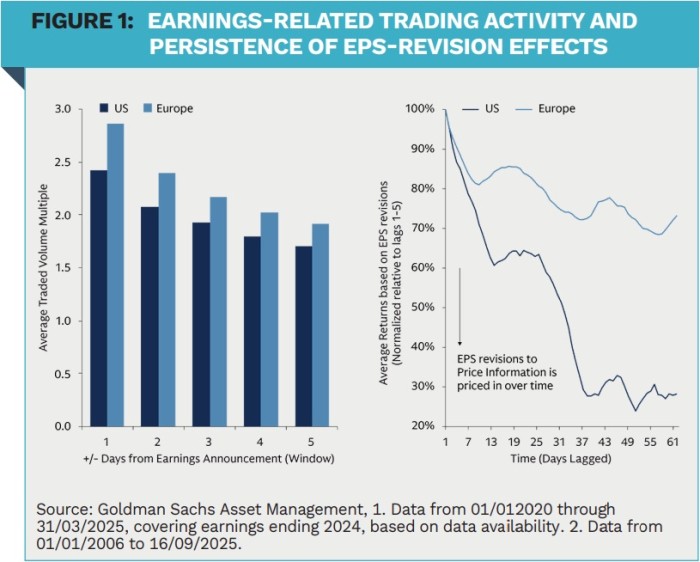
These inefficiencies lead to information travelling more slowly in Europe, sustaining pricing anomalies longer. Momentum signals have historically shown stronger and more persistent efficacy in Europe compared to the US. Trading activity in Europe spikes more around earnings announcements, suggesting greater informational value concentrated in formal disclosures, and the market’s reaction to sell-side earnings per share estimate revisions also decays more slowly: after 63 days, the average daily realized excess return attributable to such revisions remains at about 73% of its initial five-day impact in Europe, versus falling to 28% in the US. Together, these features point to a less efficient mechanism and a longer window to exploit informational edges.
Unlocking the alpha paradox with quantitative precision
Because of these dynamics, Europe offers rich alpha potential, yet extracting it can be difficult for traditional approaches. The region’s breadth and heterogeneity raise coverage challenges – complex, non-intuitive drivers of returns are hard to synthesize by human judgment alone – and slower, discretionary processes may miss fleeting inefficiencies.
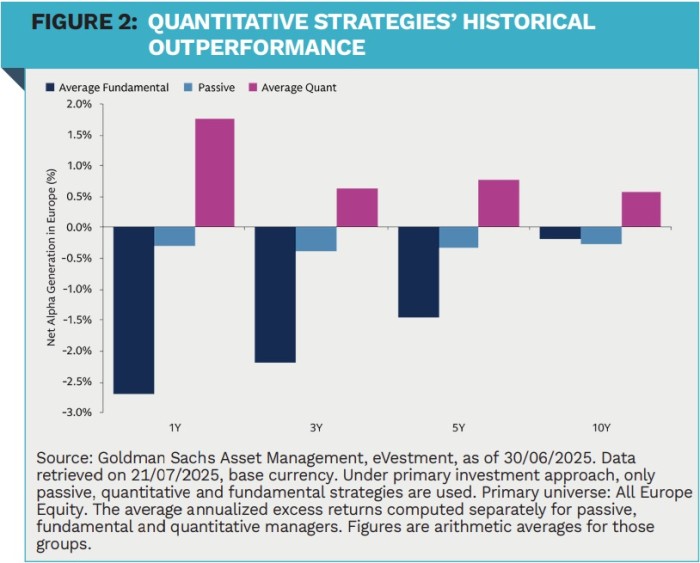
Considering all investment approaches, active managers in Europe have a higher outperformance success rate compared to US counterparts, with 69% of active Europe managers achieving positive excess returns of 0.82% on average over the last 10 years, compared to only 42% of US managers with an average underperformance of -0.41% (ending 30/06/2025). However, positive performance has been skewed toward more datadriven approaches, with quantitative strategies historically outperforming fundamental approaches across various time horizons, thereby underscoring the efficacy of these methods in such a complex market.
Turning complexity into a systematic advantage
In our view, the effectiveness of quantitative approaches stems from several key advantages that structurally align with the region’s alpha dynamics:
- Panoramic insight: Systematic methods cover the full European equity universe, overcoming sparse and uneven information.
- Augmented perception: Advanced analytics and machine learning may help reveal higherdimensional patterns and non-obvious correlations that humans may miss.
- Unified, scalable process: Fragmented signals are consolidated into a single, consistent framework that unifies and scales across countries, sectors, and other less-intuitive market segments, along which insights might otherwise remain disparate.
- Dynamism: The ability to react swiftly to new data is crucial for capitalizing on temporary informational asymmetries, enabled with automated data ingestion, modelling, and execution that can timely action on opportunities before they dissipate.
By integrating these capabilities, quantitative investors can identify and exploit subtle inefficiencies and structural dynamics more consistently, translating Europe’s informational lag and fragmented structure into repeatable, scalable alpha. Systematic approaches function as precision tools, efficiently drilling through noise and heterogeneity to surface actionable signals across the region.
Capitalizing on an evolving landscape
Europe’s equity market presents compelling opportunities for alpha potential generation through fragmentation, complexities and inefficiencies, which we believe quantitative strategies are well positioned to transform into competitive advantages. This inherent alpha potential is now significantly bolstered by important drivers of beta returns, from ambitious fiscal initiatives, such as Germany’s proposed € 500 billion infrastructure fund and rising defense spending across the continent, to reindustrialization efforts creating emerging opportunities in sectors like industrials, energy, and infrastructure.
In our view, the confluence of these macro tailwinds with Europe’s structural alpha characteristics strengthens the case for allocating to systematic European equity strategies today, in particular, through systematic, data driven strategies, which we believe to be well positioned to identify and capture evolving sources of differentiated returns.
1 Source: Goldman Sachs Asset Management, MSCI, Bloomberg (Analysts), Dow Jones (News
|
SUMMARY Europe’s diversity and fragmentation along lower and dispersed informational coverage create high market inefficiencies, from complex stock price relationships to slower price discovery, enabling relatively abundant alpha potential. The factors that contribute to Europe’s alpha potential also bring challenges for certain investment approaches. Quantitative strategies are best placed to overcome these by processing sparse and complex information dynamically and at scale, transforming Europe’s complexity into a systematic advantage. |
|
Disclaimer This is a marketing communication. Capital is at risk. Views and opinions expressed are for informational purposes only and do not constitute a recommendation by Goldman Sachs Asset Management to buy, sell, or hold any security. Views and opinions are current as of the date of this presentation and may be subject to change, they should not be construed as investment advice. 472428-OTU-2411703 © 2025 Goldman Sachs. All rights reserved |