
Foundation of the revolution (roundtable ‘AI & Blockchain’ part 1)
This report was originally written in Dutch. This is an English translation.
In part 1 of the roundtable report “AI & Blockchain”, participants outline how both technologies reinforce each other. AI requires reliable, decentralised infrastructure. Blockchain provides that. Together, they form a new digital backbone for financial markets, with major implications for trust, ownership and transactions.
By Hans Amesz
This is part 1 of the report. Part 2 will be published on Monday 9 February, part 3 on Thursday 19 February, and part 4 on Monday 23 February.
|
CHAIR Ralph Wessels, Chief Investment Strategist, ABN AMRO Bank
PARTICIPANTS Han Dieperink, Auréus Ruud Hendriks, Startupbootcamp & The Innoleaps Group Patrick Lemmens, Robeco Axel Maier, MDOTM Stefan Singor, a.s.r. vermogensbeheer Ruud Smets, Theta Blockchain Ventures Pim Swart, Maven 11 Frans Verhaar, bfinance |
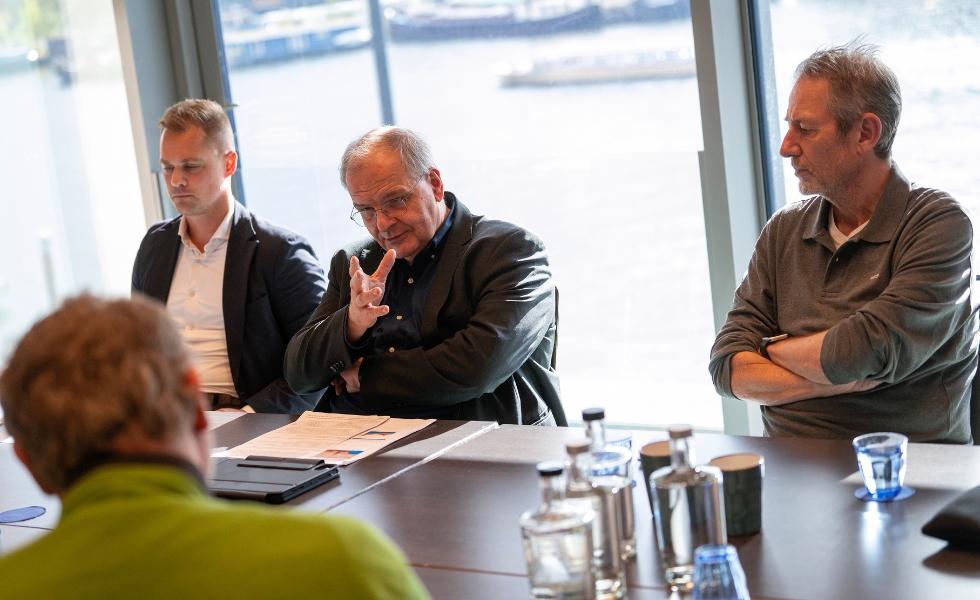
Eight experts shared their views on the revolution that blockchain and AI will unleash in the investment industry during a roundtable discussion organised by Financial Investigator. How do they see developments unfolding in the future? What are the participants already seeing happen? And is the sector responding to the opportunities and risks in a timely manner?
Moderator Ralph Wessels, Chief Investment Strategist at ABN AMRO, opened the discussion with an observation about the speed of AI's advance. ‘This revolution is happening so fast that many are unable to keep up. Resistance is normal when change happens faster than people can handle. For mass adoption, people need to be able to trust technology. That's where regulation comes in.’
The discussion focused on how artificial intelligence and blockchain reinforce each other and will reshape the financial sector. The participants also shared their views on the similarities between AI and blockchain, the role of regulation and politics, Europe's lag and the opportunities for investors in the new digital age.
What is the connection between AI and blockchain and where do they converge?
Ruud Smets: ‘As we enter the era of artificial intelligence, blockchain provides the necessary underlying infrastructure. For example, by distinguishing between humans and machines. After all, AI makes it more difficult to tell the difference between human and AI activities. And when AI systems themselves become economically active, blockchain is the rails on which they can operate. Blockchain can also assign intellectual property rights to AI systems. Finally, the decentralised nature of blockchain networks provides an essential counterbalance to the centralising power of large AI platforms.’
Pim Swart: ‘Blockchain can provide transparent and verifiable guardrails for AI: it offers a reliable infrastructure. It does indeed counterbalance the centralising power of AI, which could also become commercially valuable in the long term. Think of decentralised networks that can make all kinds of resources for AI, such as data and hardware, available without an intermediary, or, for example, micropayments between AI agents.’
How are institutional investors integrating AI and blockchain, and which applications are promising?
Han Dieperink: ‘We mainly use AI to optimise our software and networks. What used to take months now takes days. AI also supports data analysis and stock selection, although the results remain mixed. On the client side, AI can automate administration – notes, summaries and input for client visits – so that advisors can really focus on the client relationship.’
Big Tech dominates because it controls three scarce resources: talent, data and hardware.
Patrick Lemmens: ‘Everyone wants to use AI, but success depends on the quality and accessibility of data. I think we have seen this year that IT infrastructure companies have struggled to increase their revenues. They are achieving less revenue growth because many companies are still figuring out exactly what they want to do with AI. Many companies are still experimenting.’
Axel Maier: ‘We are seeing a “pilot project paradox”: many companies are launching small AI pilots in investment processes, research or reporting, but these are failing without an overarching vision from senior management. Without that direction, the use of AI remains fragmented. Asset managers are using it for mass personalisation, but without a strategic plan, progress is stalling.’
Stefan Singor: ‘We approach AI strategically and link it to our core objectives: cost efficiency, buy-out propositions, balance sheet management and, increasingly, ESG. One priority is machine learning, with neural networks and predictive models to forecast variables such as inflation that influence investment decisions. Another is reinforcement learning, which allows us to improve traditional optimisation models such as Markowitz and Black-Litterman with more data and more accurate calibration. Generative AI is also a priority: from internal chatbots to emerging agentic AI systems. The idea that agents can autonomously build and refine AI models is both exciting and transformative for the asset management industry.’
Research from MIT suggests that only 5% of AI applications in companies are profitable, mainly because people don't know how to apply them effectively.
Maier: ‘That's right. Our research with EY shows that isolated pilots rarely scale up. Successful companies first formulate a ‘North Star’ for AI, start small, and then expand step by step. Once AI takes over repetitive work and people can focus on interpretation, productivity and profitability increase.’
Ruud Hendriks: ‘I don't recognise that 5% figure at all. My productivity has increased enormously: AI answers most of my emails and WhatsApp messages.’
Dieperink: ‘Once something becomes free – such as emails instead of letters – further productivity growth is difficult to measure. The same applies to AI: the impact is real, but only appears later in the statistics. Replacing someone with an AI machine is not a productivity increase, but you only see that when people do more or better work with AI.’
Singor: ‘It's not just about efficiency; quality also improves. For example, I now trust chatbots more than my own translation skills.’
Smets: ‘It's interesting that we mainly talk about AI. Blockchain is a different type of technology: not an efficiency tool but a new decentralised layer of infrastructure, built from the ground up by start-ups. It will completely replace many centralised systems. For example, why would you pay 10% to Western Union when you can send money directly over the internet, immediately, 24/7, and for a few pence?’
The productivity gains may seem small now, but in ten or fifteen years' time, the impact will be enormous. However, the risks are just as great.
Dieperink: ‘As investors, we focus primarily on the front office. The real impact of blockchain lies in the back office, in tokenised securities and transaction processing.’
Maier: ‘AI learns and makes decisions, blockchain records and verifies. The combination can redefine transparency and governance in asset management. Blockchain guarantees data quality – crucial for AI models – and creates systems that are both intelligent and reliable. Once companies jump on the AI bandwagon, they can no longer avoid using blockchain.’
Frans Verhaar: ‘Since 2022, we have seen a clear acceleration in the use of AI among asset managers. It is no longer experimental; everyone is applying it somewhere: in research, risk, reporting or operations. The question now is whether it really adds value or is still mainly marketing. On the equity side, some managers are building entirely AI-driven models. Others use AI to refine quantitative models and find signals that older models miss. In discretionary strategies, AI does not replace humans, but it does accelerate important processes, such as screening equities and collecting data. That saves a lot of time. It allows smaller teams to compete more effectively.’
|
Ralph Wessels Ralph Wessels is Chief Investment Strategy at ABN AMRO, where he has been working since 2011. He is jointly responsible for investment policy and communicating this to clients. He regularly shares his insights via RTL Z, the FD and BNR Nieuwsradio. He has been actively following developments in the crypto world since 2017. He started his career at Robeco and studied Business Economics at Erasmus University Rotterdam. |
|
Han Dieperink Han Dieperink is an experienced investment professional with over 30 years of expertise in asset management, as Chief Investment Officer at Auréus (2020-present), Rabobank (2009-2019) and Schretlen & Co (1995-2009). He is also the owner of HD Capital & Advisory, a columnist, and an advisor to various financial organisations. |

|
Ruud Hendriks Ruud Hendriks is a versatile entrepreneur with a rich background in start-ups, innovation and media. He holds important positions within Startupbootcamp and the Innoleaps Group, has a wide range of advisory positions and gives many international speeches, including his annual forecast for the next 18 months in the tech industry: The State of Tech. |

|
Patrick Lemmens Patrick Lemmens is Lead Portfolio Manager and a member of Robeco's Thematic Investing team, where he has worked since 2008. He focuses on financial institutions and fintech. He began his career in the investment world in 1993. Lemmens holds a Master's degree in Business Economics from Erasmus University Rotterdam and is a certified European financial analyst. |

|
Axel Maier Axel Maier is Partner and Global Head of Business Development at MDOTM Ltd, a provider of AI-powered investment solutions. With over 30 years of experience in asset management, he has held senior positions at Macquarie Investment Management and Wellington Management, among others. He has extensive board experience in various markets and expertise in business development, team building and acquisitions. |
|
Stefan Singor Stefan Singor is a quantitative investment strategist with a PhD in Financial Mathematics and 15 years of experience in ALM for insurers. He specialises in strategic asset allocation, hedging strategies and scenario analysis, among other things. Within the Innovation Lab of a.s.r. asset management, he has senior responsibility for applying AI and data science to improve investment decisions. |

|
Ruud Smets Ruud Smets is Managing Partner and CIO at Theta Capital Management, an investor in blockchain venture capital. With master's degrees in information technology and investment theory, Smets combines financial insight with blockchain expertise. |

|
Pim Swart Pim Swart is an Associate Partner at venture capital fund and asset manager Maven 11. He has been active in the crypto sector since 2016. In 2020, he researched how arbitrage and market microstructure develop within blockchain networks during his MSc in Science and Business Management at Utrecht University. At Maven 11, he focuses on innovative investments in digital financial infrastructure. |

|
Frans Verhaar Frans Verhaar studied Business Administration and has been working at bfinance since 2007, an international consultancy firm specialising in investment issues for institutional investors. Verhaar has extensive experience in areas such as alternative investments, financial risk management, investment analysis and financial data science. |