Colesco Capital: Circular economy offers ample opportunities for impact

In today’s geopolitical context, the circular economy offers environmental, strategic and investment opportunities by decoupling growth from virgin resource use. Despite EU policies to target higher recycling, circularity rate growth is stagnating across member states. Scaling up circular innovations is crucial.
By Ward Heij, Business Development Manager Circular Credit, and Katy Husband, Sustainability Associate, both at Colesco Capital
For investors, the circular economy creates opportunities to advance critical technologies which reduce reliance on virgin materials, moving towards more self-sufficient, closed-loop production cycles. It decouples economic activity from resource use, catalysing business growth without increasing demands for primary raw materials.
The environmental necessity of transitioning from linear to circular
According to the Circularity Gap Report 20251, only 6.9% of the 106bn tonnes of materials used globally come from recycled sources, with growth in material consumption outpacing population growth. Our linear economy is breaching the natural resource constraints of our planet at an environmentally unsustainable rate.
What is the environmental impact of a linear economy? Extraction, transportation, and processing of raw material is responsible for over 90% of global biodiversity loss and water stress, and over 55% of global CO2 emissions in 2022.2 Replacing linear value chains with circular ones is essential to keeping within the nine planetary boundaries3,4, ensuring the planet remains a liveable environment for future generations.
The strategic role of circularity in supporting EU resilience
Circularity is strategically advantageous due to its prospects in enhancing EU resilience in the context of critical raw materials (CRMs). The EU Critical Raw Materials Act (CRMA) identifies core CRMs which are vital for ‘strategic’ sectors (defence, transition, digitalisation). Such materials include aluminium, cobalt, graphite, lithium, manganese, and rare earth materials. The overlapping demand for CRMs has a compounding demand impact in an import-reliant market (mainly sourced from China).
EU resilience and supply chain independence can be supported through preventing CRM waste and meeting accelerated demand with supply from recycling rather than imports. The average EU end-of-life recycling rate across 34 CRMs is currently only 8.3%, according to the Institute for European Environmental Policy5. The CRMA aims to increase recycling capacities to meet up to 25% of EU demand by 2030.
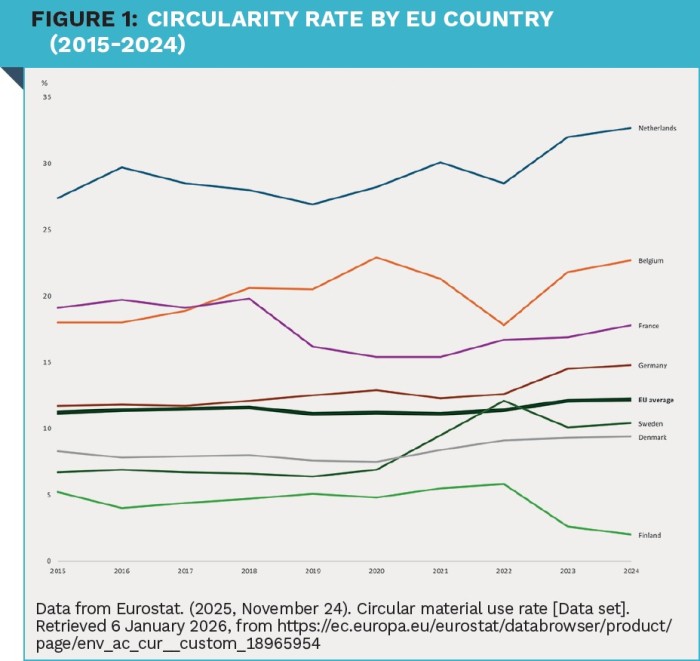
The sluggish circularity rate In 2026, the EU will implement the Circular Economy Act6 . This aims to establish a sizeable market for secondary raw materials. The EU average circularity rate – the percentage of all materials used which are recycled or reused – stands at 12.2% (see Figure 1), achieving a sluggish 1% increase since 2015. This Act seeks to accelerate progress to reach 24% by 2030. The Netherlands leads with a circularity rate of 32.7% in 2024, contrasting with Finland (2%). This wide variation is mainly explained by waste generated from mining, reinforcing the circularity benefits from reducing demand for new mining. The sluggish increase in circularity, alongside growing EU consumption, underlines the necessity of developing novel technologies that enable circular material flows. This means supporting innovative circular businesses throughout their company life cycle, as start-ups and scale-ups are crucial in bringing innovations to the market.
How can investors support the development of novel circular technologies?
Up-scaling a novel technology is characterised by four distinct phases:
- Discovery: research into the core innovation until experimental proof-ofconcept, often in a lab setting.
- Development: prototyping and testing in a pilot environment, aimed at technological de-risking.
- Demonstration: testing in an operational environment, often de-risking the technology at scale while proving commercial viability.
- Deployment: introduction into a market environment, fully technologically and commercially de-risked.
Over the course of these four phases, a funding gap emerges. Phases 1 and 2 are focused on developing the core technology and are typically funded by a wellestablished mix of regional, national and European grants, as well as angel investors and venture capital funds. Phase 4 is typically funded by infrastructure funds and traditional lenders as the projects have limited remaining risks. It is Phase 3 that has the largest funding gap. The scaling of circular technologies often requires the construction of a first-of-a-kind (FOAK) factory to technically and commercially demonstrate the innovation at scale. High capital expenditure, unmitigated performance risks, feedstock quality and availability, permitting, and regulation make FOAK projects less well-suited to many equity investors and traditional lenders.
Demonstration projects therefore typically rely on a mix of strategic corporate investors, specialised climate equity and credit impact funds, family offices, and government grants. Most demonstration phase risks, however, can be mitigated by properly allocating and structuring risks across the project value chain7. Examples of risk-mitigation measures:
- For projects that require long‑term supply and offtake contracts, ensuring on-spec availability of feedstock and reliable cash flows, especially when products are sold at a premium.
- Public support and adequate regulation, creating a level playing field.
- Performance guarantees from individual original equipment manufacturers or engineering, procurement and construction (management) (EPC(M)) contractors, which can mitigate construction, ramp-up and operational risks.
- Securing loans with project assets, real estate and potentially intellectual property, and providing lenders with clear step‑in rights.
Private credit is a well-suited instrument for innovative FOAK financing. Lenders can tailor drawdowns, tenors and other terms to non-standard risk profiles and typical FOAK development timelines and price their returns accordingly. Furthermore, lenders can introduce and enforce cash discipline, which is crucial to ensure further scale-up perspective post-FOAK.
Communicating impact outcomes, measurement and reporting
Circular project outcomes are covered by established impact frameworks, such as the GIIN’s IRIS+ impact measurement framework. In December 2025, the GIIN launched the IRIS+ Waste Management and Circularity impact theme, aiming to support impact measurement of circular investments. They set four strategic goals, with accompanying metrics:
- Minimise waste through circular design principles for products and manufacturing.
- Optimise resource use through business models that maximise utility and extend product lifetime.
- Optimise infrastructure for capturing, recycling and disposing of waste.
- Just and equitable resource management and supply chain for all workers.
Such frameworks provide investors with a common language to describe project impacts, standardise targets and metrics, and better substantiate impact outcomes for FOAKs.
Connecting capital with purpose
Overall, when approached correctly and when there is aligned risk appetite, circular FOAKs can be attractive private credit opportunities as they can offer sizeable, predictable cash flows while providing downside protection. Through providing stable finance, sustainable investors can achieve impact by supporting the critical demonstration phase of novel circular technologies, ultimately contributing to a more circular and resilient economic system.
1 https://www.circularity-gap.world/2025
2 https://www.resourcepanel.org/reports/global-resources-outlook-2024#report
3 https://www.stockholmresilience.org/research/planetary-boundaries.html
4 https://www.ellenmacarthurfoundation.org/articles/how-the-circular-economy-can-help-us-stay-within-planetary-boundaries
5 https://ieep.eu/publications/circularity-gaps-of-the-european-critical-raw-materials-act/
6 https://environment.ec.europa.eu/strategy/circular-economy_en
7 https://publications.tno.nl/publication/34645266/fgPurDxW/TNO2025-R12523.pdf
|
SUMMARY In today’s geopolitical context, the circular economy offers environmental, strategic and investment opportunities by decoupling growth from virgin resource use. EU policies target higher recycling across member states, but circularity rate growth is stagnating. To increase circularity, scaling up circular innovations is crucial. Scale-up risks can be mitigated via supply/ offtake, regulation, targeted guarantees, and lender securities, making circular first-of-a-kind projects compelling private credit, impact-aligned deals. |
Read the original article in Financial Investigator magazine