Harry Geels: Five fallacies held by supporters of a high inheritance tax
This column was originally written in Dutch. This is an English translation.
By Harry Geels
In virtually all Western countries, the debate over inheritance tax – with grand talk of ‘fairness’ and ‘equal opportunities’ – is flaring up once again. This is remarkable, as for decades inheritance tax had been relegated to the political sidelines due to its unpopularity among voters. But anyone who examines the current debates will see that many of the arguments are based on fallacies.
In Germany, inheritance tax is once again a bone of contention within the government. In early 2026, the SPD published plans to reform inheritance tax and impose heavy taxes on large estates, with the aim of achieving ‘greater fairness’. The conservative coalition partner viewed this as ‘a frontal attack on family businesses’. The debate is fierce. In Germany, inheritance tax has now become a symbolic battle over who determines the country’s economic course.
In Austria, a political storm erupted after the Chamber of Labour (AK) signed a petition calling for ‘fairer taxation of the super-rich’, including higher inheritance tax. The reaction from the business community and the conservative parties was scathing: inheritance tax would harm businesses and stifle investment. The Austrian Federation of Industry said: ‘We need a very clear rejection of inheritance tax and other new taxes’.
In France, finally, inheritance tax is part of the broader battle over the 2026 budget. Left-wing parties are pushing for the ‘Zucman tax’ on large fortunes. The inheritance tax debate has also taken on a European dimension because ECB President Christine Lagarde – acting outside her remit, incidentally – publicly distanced herself from ‘capital flight’ levies (wealth and inheritance taxes), further exacerbating the tensions between progressive tax ideas and economic reality.
Fallacy 1: The government spends money better than families
Supporters of (high) inheritance tax often assume that money in the hands of the state is automatically used more effectively than when it goes to heirs. That is an unproven assumption. Government spending is subject to political incentives, bureaucratic inefficiency and, at times, opportunistic agendas. Assuming that the government, by definition, uses the money ‘better’ is therefore premature. Indeed, in recent decades we have seen that an ever-expanding government goes hand in hand with greater inequality.
Fallacy 2: Inheritance tax substantially reduces inequality
The idea that inheritance tax solves inequality is economically naive. Inequality stems from numerous other structural factors: market power, monetary and banking policy (and possibly even government policy). The contribution of inheritances to overall inequality is relatively limited, and inequality persists even in countries with high inheritance tax rates. It is a fallacy to suggest that taxing estates acts as some sort of grand ‘equaliser’ for society.
Fallacy 3: Ignoring behavioural responses from citizens
High inheritance tax leads to different behaviour: testators/parents spend more during their lifetime, make gifts earlier, shift assets or engage in tax planning. In other words: the taxable wealth shrinks before it can be taxed. This undermines the intended effect on inequality and, moreover, makes the tax revenue lower than hoped for. Nobel laureate Milton Friedman explains this in great detail in a 4.5-minute discussion with a proponent of a 100% inheritance tax.
Fallacy 4: The moral superiority of the state over the family
The fourth fallacy is the idea that the state has a stronger moral claim to private wealth than the family that built it up. Proponents often say: ‘Heirs have not earned it themselves.’ It is a category error to judge an inheritance using criteria (‘merit’) that apply to income, not to property. In our tradition, the government is not the natural owner of private wealth; that lies primarily with families. Elevating a political preference to moral truth is a classic ‘moral high ground’ fallacy.
Fallacy 5: Ignoring democratic reality
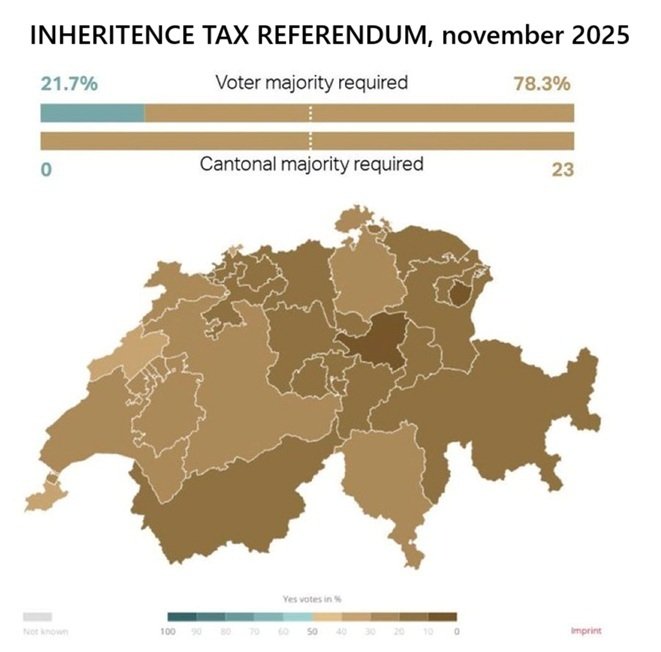
Perhaps the most striking fallacy: that most people would want it. On the contrary, there is not a single recent example in a democratic country where a majority voted in favour of increasing inheritance tax. For instance, in November 2025, the Swiss population overwhelmingly rejected a federal inheritance tax of 50% on large estates. 78.3% voted against it, and not a single canton supported the measure.
In the UK, various polls were conducted last year on inheritance tax (including by The Independent and IPSOS), and a clear majority want to abolish or reduce it. 43% of Britons even cite inheritance tax as the most unfair of nine taxes surveyed. In recent decades, several countries have abolished inheritance tax because it is so unpopular, for example New Zealand, Australia, Portugal, Estonia, Latvia, Norway, Sweden, Austria and Mexico.
Yet proponents of (high) inheritance tax continue to insist that their position is morally superior, as if the public ‘doesn’t understand yet’. Denying the democratic preference of citizens – who broadly reject inheritance tax – is a false appeal to moral authority. Instead of questions such as: ‘Does inheritance tax work?’, ‘Is it economically desirable?’ or ‘Does it have democratic support?’, the frame shifts to: ‘Are you a good person?’ This makes a genuine discussion impossible.
In conclusion
The current wave of inheritance tax debates shows that many political arguments rely on wishful thinking, moral framing and economic simplification. The five fallacies described above recur in virtually every country. At the same time, the outcome of such debates is surprisingly consistent: when citizens are truly allowed to choose, as in Switzerland, they resolutely reject (high) inheritance tax. Incidentally, what do terms such as equality and justice actually mean?
This article contains a personal opinion by Harry Geels