
Fawaz Gerges: Integration of Israel into the Middle East is an absolute necessity
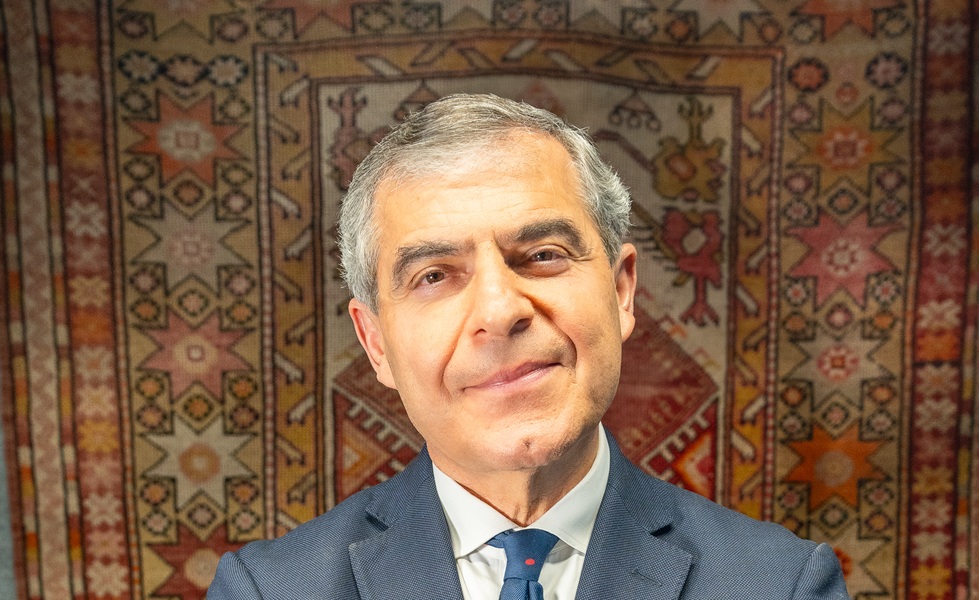
This interview was originally written in Dutch. This is an English translation.
The spiral of violence has gripped the Middle East for decades. It is part of a difficult process towards self-determination for local populations, who are structurally oppressed in most countries in the region. For more than a century, foreign powers have protected authoritarian regimes. Israel's role in this is crucial. The country must integrate into the region. Otherwise, the spiral of violence will never end.
By Joost van Mierlo
Lebanese-born American academic Fawaz Gerges is considered one of the most authoritative experts on the Middle East. In his most recent book, The Great Betrayal, he exposes the causes of the ongoing spiral of violence in the region. According to Gerges, the strategic interests of foreign powers – centred on oil and geopolitical issues such as the Cold War – have kept authoritarian regimes in power throughout virtually the entire Middle East.
The population is rebelling, Gerges argues. According to him, this is evident in countries such as Iran, Sudan and Libya. How quickly things can change was demonstrated a few years ago in Syria. The government of Bashar al-Assad was unpopular, but there were no signs that it was about to fall. However, after a new uprising by the people in 2024, the regime fell within two weeks. 'That will happen elsewhere too,' says Gerges, 'although no one knows exactly when.'
In your book, you talk about deception of the Arab population. What do you mean by that?
'At the end of the First World War, the British and French promised the Arabs in the Ottoman Empire that, in exchange for resisting the Ottoman rulers of the time, they would be integrated into a large Arab empire. This would happen in exchange for the creation of a Zionist state, later known as Israel. This promise was broken. This applies not only to the Palestinians and the Kurds, but to all Arabs.'
The problems of the Middle East were in fact created after the First World War.
'England and France thought they could control the problems in the region by, as it has come to be known, 'drawing lines in the sand'. The idea of the nation state was imposed on the region. It did not exist before. The Ottoman Empire was home to various religious and ethnic groups, which operated as tribes.
They were replaced by countries such as Iraq, Jordan and Palestine, which were effectively colonies of the United Kingdom, and Syria and Lebanon, where France ruled the roost. Autocratic leaders were appointed in all these countries, with the sole task of creating peace. However, the only thing these autocratic leaders invested in was a powerful army that brutally suppressed any form of resistance. No investment was made in education, democracy or the principles of the rule of law. It is a situation that has hardly changed in all these years.'
Colonialism disappeared after the Second World War. How is it that nothing has actually changed since then?
'You could call it ‘the curse of oil’. After the Second World War, there was enormous optimism in the region. People hoped that the United States, as the new political superpower, would put an end to political oppression. But that did not happen. This is partly due to oil. The region has 65% of the world's oil reserves. Western countries want access to those reserves. That is why they have always protected the autocratic regimes.
Perhaps the most crucial moment was the coup supported by the US and the United Kingdom in 1953 to depose Iranian Prime Minister Mohammed Mosaddegh. He was the most liberal leader the Middle East had ever had and implemented reforms in the area of workers' and women's rights, which were based on his fondness for the United States. However, he had made one mistake. He nationalised the oil sector. That was unacceptable in the eyes of the US. It is one of the reasons why the US is still not really trusted by large groups of Iranians, even now.
Trump's peace plan is a US diktat without any input from the local population. It simply cannot work.
In addition to oil, the Cold War played an important role in the support of foreign powers, especially the United States, for autocratic regimes. This played a major role in Egypt, for example, where Gamal Abdel Nasser staged a coup in 1952.
Nasser initially had good relations with the United States. With the Cold War, in which the US could declare countries public enemies overnight, the attitude towards Nasser and Egypt changed. Nasser's regime was gradually undermined, as it were, with a thousand knife stabs, but the result was at least as effective.'
Foreign interventions have caused great mistrust in the Middle East. What do you notice about that at the moment?
'This is most evident in the situation surrounding Israel. I spoke earlier about the deception of the Arab population after the Second World War. That does not mean that Israel has no right to exist. Certainly not. The injustice done to the Jewish population during the Second World War is unprecedented in history.
At the same time, you could say that the problem Western countries experienced with Jews – and that is a historical fact – has, as it were, been shifted to the Middle East. That is acceptable as long as Israel behaves like a country that accepts that it is located in the Middle East. But that is increasingly less the case.'
What do you mean by that?
'The Palestinians have recognised Israel since the 1970s. I am referring to Yasser Arafat's PLO. In 2002, all Arab countries declared that they would recognise Israel. However, the condition was that a Palestinian state would be established. At the moment, however, that seems further away than ever. This is partly due to the horrific attacks by Hamas a few years ago. But even before that, the position of the Palestinians was undermined by the settlements on the West Bank. And however horrific the Hamas attack was, it cannot justify the genocide that took place in Gaza.'
What is your view of the American peace plan that is currently being implemented?
'It is a new example of foreign intervention in the region. It is a dictate from the US without any input from the local population. It simply cannot work.
The Peace Council proposed by US President Trump is a kind of alternative United Nations. The big difference, however, is that the United States is in charge. It is a body designed to stroke Trump's ego. Its board consists of the most hardcore defenders of Israel in the Trump administration. Former British Prime Minister Tony Blair is the only “foreigner”. However, his reputation in the Middle East is not very good. This is of course related to the Iraq war, but perhaps his period as Middle East negotiator for the United Nations between 2008 and 2015 was even more disastrous. At that time, he lost all credibility with the Arab countries with his pro-Israel stance.'
I am a fierce opponent of military intervention. The situation in Iran is tragic, of course, but it is up to the Iranian people to determine their own fate.
What needs to happen?
'The recognition of a Palestinian state is an absolute prerequisite. It seems that Israel wants to solve the Palestinian problem by accommodating all Palestinians in Jordan. That is an unacceptable solution. It means that the spiral of violence will never be broken. Israel should realise this. Of course, we are not talking about a Palestinian state “from the river to the sea”, as you hear in the slogans of pro-Palestinian demonstrators in London and elsewhere. But we are talking about the West Bank and Gaza, something that has been agreed upon in the United Nations.
The reality, however, is that there are currently no Israeli politicians who support this, certainly not since the Hamas attacks in southern Israel. However, the issue must be put back on the table if the violence is ever to end.'
In recent months, attention has focused mainly on Iran. The Americans seem to be on the verge of launching an attack on the country. What is your view on this?
'I am strongly opposed to military intervention. The situation in Iran is tragic, of course, but it is up to the Iranian people to determine their own fate. The Iranian religious leaders have lost all credibility. The country is in ruins. Unemployment is rampant. The suppression of the demonstrators is repugnant and the anger is enormous. But that does not mean that the Americans, or anyone else, should intervene. That would give the current regime the opportunity to crack down harder on demonstrators, because they could be regarded as accomplices of Israel or the US.'
But doing nothing while a disaster unfolds before the eyes of the world is not an option either, is it?
'We are currently facing a perfect storm that could bring about major changes in the region. It is a combination of a political crisis, an economic crisis and a social crisis. The people of the Middle East have had enough of the misery they have lived in for decades.
I am referring in particular to young people. They want 'freedom, justice and dignity', the slogans you heard during the Arab Springs of 2012 and 2019. This Arab Spring has been violently suppressed everywhere, but it is a desire that ultimately cannot be ignored. You saw that in Syria in 2024, for example, which in my opinion was the most hopeful moment in the recent history of the Middle East.
The same applies to the situation in Iran. It seems as if the regime has the support of the military, but that also seemed to be the case in Syria. In my view, the same will happen in Iran. And elsewhere in the region too. It is a bloody process. But creating autonomous countries is not a flawless process. In Europe, it took more than three centuries after the Peace of Münster in 1648. In the Middle East, they have been trying for more than a century now and it is going faster, but not without enormous problems, as we experience every day.'
|
Fawaz Gerges Fawaz Gerges was born in Beirut and has a Greek Orthodox background. During one of the civil wars in Lebanon, his family was forced to move to Syria, from where they emigrated to the United States. Gerges studied at the London School of Economics and obtained his doctorate from the University of Oxford. His research focuses on the Middle East. Over the years, Gerges has published books on Al-Qaeda and ISIS, among other topics. Gerges currently teaches at the London School of Economics. His latest book was The Great Betrayal (2025). |
Read the original interview in Financial Investigator magazine