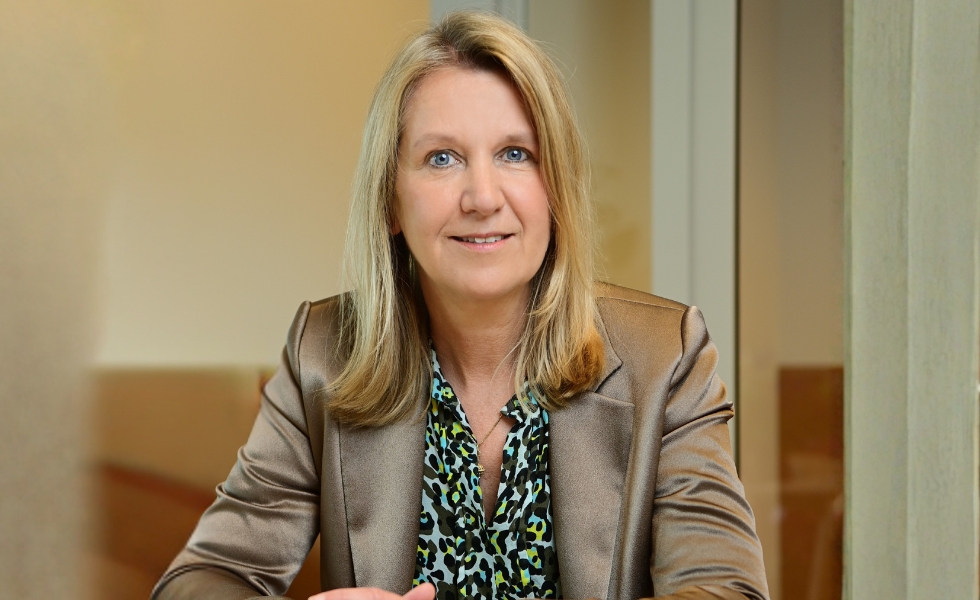
Madelon Moorlag: Grasping a complex reality
This interview was originally written in Dutch. This is an English translation
Her unstoppable drive to understand investment matters in minute detail enables her to provide her stakeholders with detailed information. Financial Investigator interviewed Madelon Moorlag, Asset Management Manager at Klaverblad Verzekeringen.
By Lies van Rijssen
‘When my sister was studying Economics in Groningen, she would always come home with interesting stories. And I’d already enjoyed Economics at school. So when I chose to study Economics in 1989, it didn’t take me long to decide. My choice of degree has led to a career that suits me perfectly. During my studies, I became fascinated by business economics and financial economics. I was particularly captivated by the interplay between business economics, macroeconomic forces and politics. I was introduced to black swans and stress scenarios.
During my traineeship at Fortis, I worked as a bank manager and mortgage specialist. At my final placement, I joined KBW Wesselius as an analyst and private banker, where I delved deeper into asset management. I soon realised that I didn’t want to remain a private banker. Stock market crashes bring with them a very different set of emotions in your role as a private banker than when you work for corporate financial institutions. It was more in my nature to study market movements from a corporate perspective, and I ultimately chose the institutional route.
I now run the asset management division at Klaverblad Verzekeringen. The Asset Management department – that’s me. Naturally, this operates within a robust governance framework at Klaverblad. I have organised things so that I work closely with our asset managers and sustainable advisor. That’s where I draw on countervailing power and expertise.
I see the focus on sustainability and associated regulations as one of the major developments in our sector in recent years. For me, the central question is how to put capital to work in a way that benefits people and their environment. I was already grappling with this question during my time at PGGM. The IMVO covenant for international corporate social responsibility was already a topical issue there at the time.
This was later introduced among insurers in 2019, not long after I joined Klaverblad. Here, I have witnessed the development of legislation and regulations stemming from the CSRD, the European directive that obliges companies to report transparently on their sustainability performance. Unfortunately, it is also a development that these regulations have already been partially scaled back.
Continuously monitoring and evaluating our risk-return profile and acting on it, as well as keeping abreast of legislation and regulations on sustainability, are key themes in my work. As I mentioned, the initially strict regulations on sustainability have since been relaxed. The ambition outpaced data quality and practical feasibility. This means, for example, that our organisation no longer needs to comply with the CSRD directive.
I remain convinced that we must stick to value creation and look beyond mere financial returns.
I understand that simplifying the regulations was necessary, but at the same time I find it a pity. In the field of sustainability, Europe was actually leading the way in creating clarity and transparency. I consider that transparency to be a great asset: in my view, it goes without saying that we should be clear-sighted and able to explain exactly where we are investing. So although the regulations were complex, we also learnt from them.
We were forced to think very precisely and to communicate transparently and concretely. I believe that, as a sector, we simply need that.
I also remain convinced that we must stick to value creation and look beyond mere financial returns. Of course, value creation and financial returns must go hand in hand. That idea is a key driving force within our organisation and also a personal motivation for me. I want to highlight this stance more explicitly in our communications with our policyholders. At Klaverblad, we also believe it is important to look beyond mere returns. We prefer to invest close to home, with quality, clarity and honesty as key principles. We believe that as an organisation, whether large or small, you can set an example.
Value creation: what are we really investing in, how can we achieve financial returns whilst simultaneously incorporating important issues such as biodiversity into our investment policy? I feel that we, as the financial sector, are at a crossroads, but we are not straying from the path towards sustainability. Not even now that regulations are less stringent. In any case, I will advocate that we continue to explore how we, as insurers, can put our money to work in such a way that it not only yields a good financial return, but also contributes to value creation, for the Netherlands and for Europe.
You could say that, as a woman and Head of Asset Management, I already partly embody our views on the importance of diversity and inclusion. Through our business operations, we further promote the importance of this internally. And it is not at all a bad thing that we occasionally experience some friction when we have parties with differing opinions at the table, each viewing issues from their own perspective, standards and values, and making that clear. That friction actually ensures that topics are examined from multiple angles before decisions are made.
Someone recently advised me to source my information not only from mainstream media but also from a few non-Western newspapers. Good advice for avoiding tunnel vision. You have to challenge yourself, even if this initially makes the playing field seem more complex. Through value creation and the ethical framework on which our investments are based, we demonstrate our convictions to the outside world. And, of course, we have firmly incorporated the relevant international treaties in these areas into our investment portfolio.
I consider transparency to be of great value: in my view, it goes without saying that we have a clear understanding of exactly what we are investing in and are able to explain it.
I have distilled a number of key insights gained throughout my career into two mottos that I have adopted as guiding principles for myself. The first – ‘begin with the end in mind’ – helps me to maintain focus in my thinking, stay goal-oriented and avoid being overly distracted on the path to the goal. My second motto is: ‘if you can’t explain it simply, you don’t understand it well enough’.
First, I want to fully understand for myself where I’m heading and why, and how the subject matter surrounding an issue works.
It may be an anomaly, but for this reason I do not want to have to rely on a team where knowledge is dispersed. I want to get to the bottom of the Excel sheets and all the documents myself and understand them fully, so that I can explain their significance to the members of our Balance Sheet Management Committee (BMC) and other parties within our organisation and beyond.
I regularly take a step back to view the subject matter through the eyes of other discussion partners. That is the major challenge in my work: fully grasping all the ins and outs of investment issues and translating and articulating them clearly, so that others can make decisions based on this that they can fully justify. Because issues that impact an investment proposal often influence one another as well, I regularly face the complex task of understanding the volume of data and interconnections, distilling them, translating them into understandable language, and sharing them with our stakeholders.
I believe that my move to Klaverblad Verzekeringen has been the most significant moment in my career so far. I was probably ‘unconsciously competent’ at the time, but I still had doubts as to whether I would be capable enough to perform this role effectively. I took the plunge, tackled the figures and balance sheets head-on, set about unravelling exactly what was happening, and then set about reforming this department. My primary task was to gain a clear picture of the interest rate risk we were exposed to.
Here, I learnt to show more courage as a person and to have confidence in myself. By getting stuck in and using my common sense, it became increasingly clear to me that I had indeed entered this role with unconscious competence. Realising that and discovering that this role and I were indeed a good match was a wonderful experience.
I regularly face the complex task of making sense of the vast amount of data and connections, distilling it and translating it into understandable language.
I’ve been working here for eight years now and can say that I have an absolutely brilliant job. I love being at the forefront of asset management, having been able to implement sustainability into the portfolio, and taking on the challenge of engaging BMC members in such a way that the investment proposals become manageable for them. This role is very diverse. I am also able to perform so well here because this organisation has been convinced from the outset that financial returns and social returns go hand in hand. That vision has guided the structure of our investment portfolio since 2019.
I believe in the goodness of the economy and society around me, even though I regularly note, to my disappointment, that the pursuit of profit still prevails in many places.
And yet I remain inspired by the interplay of forces that determines how to put your money to work in a meaningful way, so that it also contributes to a purpose beyond mere financial return. This is where the question ‘what brings us satisfaction as an organisation’ meets the question ‘what truly brings you satisfaction as a person’. Doing the right thing based on the conviction that this will ultimately pay for itself, and communicating this crystal-clearly. In words, but also through the structure of our investment policy.
At Klaverblad, the sustainability policy begins with the ethical framework – a social foundation – and then focuses on the themes of climate and biodiversity. Thanks to my role as a director at VisioFoundation, I can contribute even more to the social pillar. From that position, I can use my investment experience to support projects that genuinely improve the lives of people with visual impairments. VisioFoundation contributes a substantial amount each year to national and international initiatives in areas such as education, care, rehabilitation, treatment, employment, day care, housing and accessibility.’
|
Madelon Moorlag Madelon Moorlag is a Business Economist and has been working as an Asset Management Manager at Klaverblad Verzekeringen since 2018. Prior to this, Moorlag spent eight years at PGGM Client and Product Management and nine years at ING Investment Management as a Senior Portfolio Manager and Director of Client Servicing for Institutional Clients. Moorlag began her investment career as an Analyst and Private Banker at (formerly) KBW Wesselius |