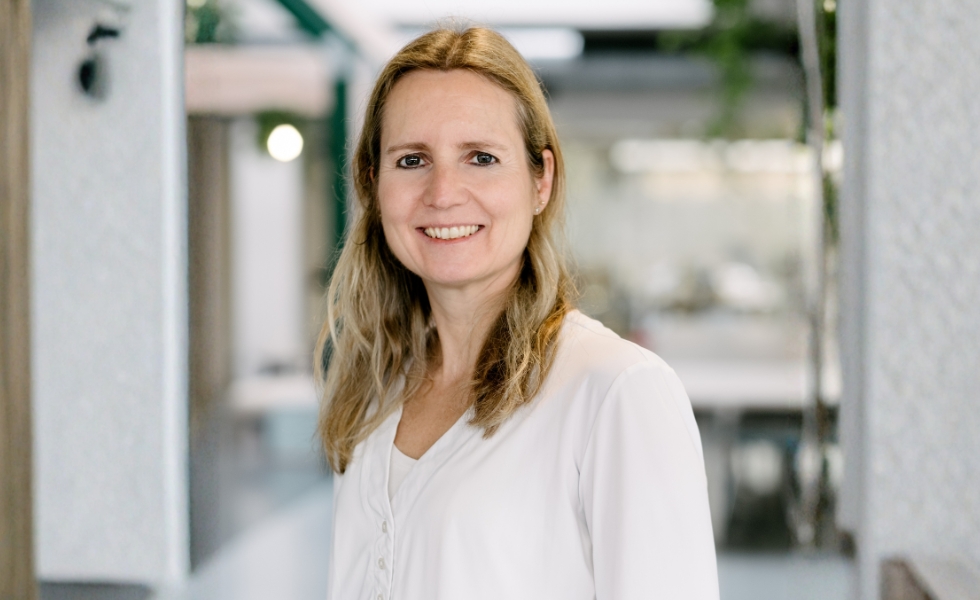
Mariska Douwens: More buzz in the workplace
This interview was originally written in Dutch. This is an English translation
She is critical, creative, analytical, and enjoys working with people. Financial Investigator spoke to Mariska Douwens, Senior Sustainable Investment Advisor at Finance Ideas.
By Lies van Rijssen
‘The financial world is absolutely my cup of tea. The work is varied and everything is constantly changing. In our decision-making models, we have to deal with many different factors, including the economy and politics. After completing my degree in Business Economics, a specialist recruitment agency secured me a position at NIBC as an investment analyst. I only worked there for a year, but I have very fond memories of the team. Those people were genuine and straightforward. Great sparring partners.
At NIBC, I was given a great deal of freedom from the outset to take responsibility for ‘my own companies’. The workload was heavy due to the constant stream of figures coming in and the speed with which we had to react. But after the tension, the camaraderie always returned and we would review how things had turned out. When NIBC stopped doing investment research, I found a similar role at Fortis Bank.
During my time at Fortis, the financial crisis broke out and I went back to university to do a PhD. Since then, I have worked at various asset management firms until I was able to join Finance Ideas last year as a Senior Sustainable Investment Advisor. Sustainable investment is truly my passion.
Pension funds, as well as many insurers, now want to make a difference through sustainable investments. I see this as one of the biggest developments in our sector in recent years. For pension funds, the transition to the new system is an additional factor.
In sustainable investing, too, the risk-return ratio remains important, but the impact on the environment, social responsibility and good governance carry significant weight. These are less tangible matters, and it has been quite difficult to put them into practice. Legislation and regulations provide frameworks for this, ensure due diligence and must prevent sustainability as a concept from being undermined by practices such as greenwashing. However, there remains room for interpretation and causality is difficult to prove.
Bear in mind that what is an optimal solution for one party is not automatically suitable for another. Context, profile, identity and associated preferences are decisive factors. At the same time, we are long-term investors, but we are required to report our performance annually. Transparency is crucial, and the trick is to assess whether adjustments are necessary or not. This requires a wide range of perspectives and considerations, and as advisers, we help our clients with this.
Don’t react on reflex, but on reflection: explore what scenarios you can expect and what your options for action are.
Sustainability and the question of how we can use capital to influence the world in a positive way are daily themes in my work. I look for options, taking into account the client’s ESG frameworks and convictions, participant preferences, risk appetite and so on. These parameters provide a framework and force you to think carefully about what is possible, but it is also important to keep testing them.
Another relevant theme at the moment is the political developments in the US. How do these affect the robustness of portfolios, given that there are many investments in US companies and we also rely so heavily on US parties for our data, technology and IT infrastructure? What will the more isolationist course that the US intends to pursue under the widely supported Project 2025 mean for our sustainability objectives and investments? The ideas behind this do not stem solely from Trump, but are deeply rooted in American culture.
Of course, we have experienced other major developments that have caused intense disruptions to the financial markets. Think of the dot-com crisis, the attacks of 11 September 2001, and Covid. It remains essential not to react on reflex, but through reflection: explore which scenarios you can expect and what your options for action are.
American companies are often reluctant to report on sustainability, fearful as they are that the US securities regulator will take action against them and urge them to focus primarily on visibly material financial matters. This makes our pension portfolios more vulnerable. Shouldn’t we be looking for alternatives? And if so, when would be the right time to make the switch? As is well known, some pension funds have already shown the door to certain asset managers because they saw insufficient alignment with Dutch sustainability standards.
A good starting point for making the right decisions is a diverse team that looks at issues from different angles and does not shy away from discussion. This reduces the risk of blind spots and increases the likelihood of broad support. Diversity and inclusion are about much more than just gender. You can also foster diversity and inclusion along other axes, such as background, age and income.
Discussions can become complex in such a diverse setting. Certainly! That is why the chairperson’s role is crucial. The chairperson must be a good process manager who understands group dynamics, maintains an overview, intervenes when necessary, reflects back, summarises viewpoints and dares to bring matters to a close. And sometimes determines that it is wiser to postpone a decision until the next meeting.
There is no such thing as the optimal solution to a problem. That is an important insight I have gained in my work. The context and identity of the parties involved are always crucial to whether or not solutions are appropriate. And the environment is constantly changing. What is a good solution today may be outdated tomorrow. Thorough research is no guarantee either. You cannot know forever how something works. Investment advice remains a human endeavour. Clients must be able to trust that, if things are adjusted at a later stage, this need not be a bad thing. Companies should allow themselves that capacity to learn.
I miss the buzz of the old office, where non-verbal communication spoke volumes about how someone was feeling.
For me, the moments of crisis I have experienced in the financial markets have been the most significant moments in my career, because they are so instructive. They force you to rethink things. About a newly emerging world view and how you can respond to it. The Covid outbreak is a good example. That moment called for calm and space to reorient oneself. But there was no calm or space at all at that time. From one day to the next, I – and many others with me – had to start multitasking and get everything done in one place: working, teaching the children, exercising, living.
Fulfilling different roles simultaneously has always been my biggest challenge in my working life. Sometimes, as a consultant, I’m heavily involved in the substance of things; sometimes I’m more of a distance observer, listening. Or I have to communicate about sensitive issues that are likely to meet with resistance. Or I’m engaged in pension education to help people progress in their development. In everything I do, I must remain authentic and be fully aware of what I’m doing. If you’re not genuine, others can tell.
In the financial world, we deal with all sorts of stakeholders, parties and interests. This can make effective collaboration on major projects a challenge. Sometimes a process seems harmonious, until decisions have to be made. Then it turns out that it’s unclear who is responsible and who owns a decision. Sometimes we involve external experts, but their input falls by the wayside on the way to yet another decision. Collaboration makes my work even more varied, but also more complex. In my private life, motherhood has been my biggest challenge, because I suddenly had even more to manage. The search, together with my partner, for a new balance in our lives was successful, but took a lot of energy.
There is no such thing as the optimal solution to a problem. The context and identity of the parties involved are crucial in determining whether solutions are appropriate or not.
I sum it up like this: challenges arise when the normal is disrupted. But the fact that we periodically have to reinvent the new normal is also healthy. It is important that, as people, we are willing to be each other’s mentors for a while to regain balance, recognise blind spots and determine which new path we are going to take together. If, at such times, you can fall back on processes you have already devised, that provides peace of mind and a sense of security. Regulations provide frameworks, but good processes are also essential.
I particularly thrive in my work when dealing with complex issues. Putting the puzzle pieces that logically belong together into place, crafting a well-founded narrative around them, and utilising my ability to think creatively and associatively to the full. Yes! However, I always need to be able to bounce ideas off people who can bring me back down from that creative and associative thinking and help me narrow things down. That way, I keep testing myself. Even in my home life, there are sometimes challenges where I really need my creative abilities.
I enjoy working with people around me. The Covid period has meant that we now very often only meet each other from behind a screen. That can be practical, but I feel we’ve gone too far with it. I miss the ‘buzz’ of the old office, where non-verbal communication spoke volumes about how someone was feeling. If you went to collect a visitor or just walked past someone’s desk, you could tell very quickly if something was up.
Perhaps that personal and direct human contact wasn’t always the most efficient in terms of time. But in the long run, it may ultimately prove more effective. After all, time is not the same as effort. Getting together in person takes time, but it doesn’t have to feel like an effort and can actually give you energy. Lots of energy. Working from home takes less time but usually yields less energy.
I look back fondly on what I learnt amidst the hustle and bustle of the dealing rooms. We watched each other at work, heard each other thinking out loud, saw each other react. It kept us on our toes! It may be different in other professions, but certainly in the investment industry, I’d like young people at the start of their careers to be able to learn from others who are physically close by, rather than just via a screen. I also simply miss being in the thick of things. We could certainly organise that sort of thing more often again. I remain optimistic about that!’
|
Mariska Douwens Investment expert Mariska Douwens studied Business Economics at VU University Amsterdam and obtained her PhD in Behavioural Finance from the Erasmus School of Economics in 2012. She has been Senior Advisor for Sustainable Investment at Finance Ideas since 2025 and previously worked at MN for around ten years, most recently as Head of Equities. In between, Douwens spent a year at PGGM as a Credit Investment Strategist. Douwens began her career in 2000 as an Investment Analyst at NIBC. She subsequently joined Fortis in a similar role, spending the last few years of that period working in New York. |
Read the full report in Financial Investigator magazine