
Fidelity International: Emerging markets, where diverse stories build resilience

Geopolitical tensions and volatile commodity markets have reshaped the emerging market landscape. Yet beneath near‑term uncertainty, structural reforms and sector‑specific dynamics continue to create compelling investment opportunities.
By Monica Li and Amber Gordon
Emerging markets (EM) were among the top performers in global equities in 2025, surpassing the US for the first time since 2017. This momentum continued into Q1 2026, with EM outperforming developed markets as investors questioned US dominance and responded favourably to robust demand from artificial intelligence and supportive commodity prices.
Performance was notably strong in the year’s first two months, before late February’s escalation of US/Iran tensions triggered a sharp shift in sentiment. The conflict led to increased volatility, higher oil prices, and broad de-risking in emerging assets. EM underperformed developed markets in March but still ended the quarter ahead overall.
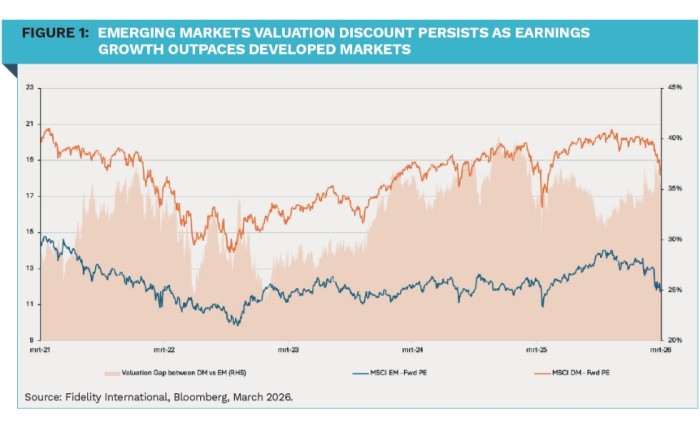
Several fundamental factors support EM’s continued outperformance. Many EM economies have a more supportive fiscal backdrop than developed markets, allowing for targeted, expansionary policies that cushion growth risks. A softer dollar lowers debt-servicing costs and imported inflation, while supporting commodity prices and local currencies, strengthening consumer purchasing power. Earnings forecasts remain favourable for EM versus DM, particularly given EM’s valuation discount.
While stresses such as the geopolitical tensions we are currently witnessing can obscure EM diversity, they also highlight the importance of selectivity. Macro and geopolitical shocks drive short-term volatility, but effects differ across economies, sectors, and companies. Structural reforms, policy priorities, and industry dynamics continue to shape diverse investment narratives, as seen in China, Korea, and India, where selective opportunities persist even in risk-off periods.
China’s leaders have heavily invested in high-tech industries to bolster self-reliance and resilience. This has underpinned China’s ascent in electric vehicles, AI, biotech, and robotics. Innovation and supportive policy now drive the economy. Despite US export controls on cuttingedge technology, ‘a growing number of chips used in China will be made locally,’ says Allen Yang, an equities analyst at Fidelity International covering China’s chipmaking industry. ‘Local semiconductor equipment makers will continue to benefit from domestic capacity expansion and supply chain localisation for years to come.’ This underscores the opportunity set emerging in China’s onshore semiconductor supply chain.
Macro and geopolitical shocks drive short-term volatility, but effects differ across economies, sectors, and companies.
In parallel, China’s pharmaceutical sector is evolving from a ‘fast follower’ to a direct R&D challenger, with a growing share of global licensing deals. Chinese biopharma firms reportedly develop drugs two to three times faster and at significantly lower costs than US or European peers. These changes signal a shift towards innovationled growth, driven by targeted policy and investment in science and technology.
Alongside these advances, China’s consumer landscape is gradually changing. Despite ongoing challenges in property and cautious spending, opportunities are emerging across the income spectrum. Demand for premium products remains strong among higher-income consumers, while value-formoney goods are gaining traction in lowerincome groups. This polarisation is reshaping competition in consumer staples and discretionary categories, offering differentiated opportunities despite subdued overall growth.
Elsewhere in Emerging Asia, Korea demonstrates the impact of structural reform on market dynamics. Korean corporates, long criticised for weak capital discipline and limited shareholder returns, are increasingly responding to policies improving governance and reducing the ‘Korea discount’. The Value-Up programme aims to enhance capital allocation and transparency, especially in finance. While reforms support a constructive medium-term outlook, Korea’s reliance on energy imports exposes it to external shocks, balancing reformdriven opportunity and macro sensitivity.
In India, the steel sector offers a domestically driven investment case. Rapid urbanisation, infrastructure investment, and favourable policies, such as extended import tariffs, have benefited domestic steelmakers, boosting earnings visibility and pricing power. With most iron ore sourced locally, the sector is less exposed to geopolitical disruption, though input and freight costs remain a consideration.
These themes highlight how EM presents diverse opportunities amid uncertainty. Geopolitical shocks and changing global trade dynamics will continue to cause volatility, but outcomes are not uniform across regions or sectors. EM consists of varied economies, policy frameworks, and resilience profiles, underscoring the need for a selective, fundamentally grounded approach.
This point is relevant to today’s environment. EM is an attractive asset class, with supportive valuations and potential for further re-rating in 2026. The fundamental outlook is positive, underpinned by strong fiscal conditions, scope for rate cuts, and robust earnings growth, driven by tech sector expansion, commodity strength, and Chinese innovation as mentioned above.
The variety within EM creates a constructive environment for stock picking. Divergence in country returns, uneven governance, and headline sensitivity mean many market segments should be avoided, underscoring the importance of selectivity. EM equities present significant opportunities for active investors. The combination of valuation support and differentiated fundamentals explains the persistence of the EM discount amid rising earnings growth.
|
SUMMARY Emerging markets outperformed developed markets in early 2026, driven by robust demand from AI and strong commodity prices. Geopolitical tensions have increased volatility, but selective opportunities persist across regions, notably in China, Korea, and India. Structural reforms, policy support, and innovation continue to underpin earnings growth and resilience in key EM economies. Diversity in EM creates a favourable environment for active stock picking, with valuation discounts and differentiated fundamentals. |