
a.s.r. real assets: An internal CO₂ price, from emissions to euros

This article was originally written in Dutch. This is an English translation.
Climate change means that CO₂ emissions are becoming increasingly relevant to financial considerations. For institutional investors, this calls for ways to factor these emissions into their decisions on a structural basis, for example by applying an internal CO₂ price.
By Patrick de Baat, Sustainability Manager at a.s.r. real assets, and Sjoerd Berkhout, Senior Portfolio Manager at a.s.r. real assets investment partners
Traditional valuation models take explicit account of the transition risks associated with CO₂ emissions only to a limited extent. These include stricter regulations, higher energy costs and the depreciation of non-sustainable buildings. This creates a tension: real risks, but incomplete pricing.
An internal CO₂ price (ICP) can reduce this tension by explicitly assigning a monetary value to CO₂ emissions within the organisation. This brings hidden costs to light and creates scope to integrate sustainability – including its financial aspects – into strategic decision-making.
Within our organisation, we apply an ICP to both direct property investments and investments in property funds.
External and internal reasons for using an ICP
CO₂ pricing takes two forms: an external CO₂ price (mandatory) set by the European Commission and national governments, and an internal CO₂ price (voluntary) set within an organisation. External CO₂ pricing operates, for example, through traditional taxation or emissions trading schemes. For investors, CO₂ taxation means that the costs of activities that generate high emissions are increased, making sustainable (or more sustainable) activities more attractive. This encourages sustainable investment in the business sector and industry.
The internal CO₂ price is the price that organisations impose on themselves for CO₂ emissions, in addition to the external CO₂ price. Organisations make a conscious choice to highlight future risks earlier than the market does. As such, an ICP primarily functions as a steering tool. An ICP can be applied in two ways: as a shadow price or as an internal cost item, whereby CO₂ emissions may or may not actually be financially offset.
Developments in the ICP
Voluntary CO₂ pricing is in its exploratory phase. At international level, there are various commercial and public sector organisations that already apply a shadow price. By applying an ICP, they create financial scope to invest in projects that achieve significant CO₂ reductions compared to an alternative, or that contribute to the creation of low-carbon buildings. At national level, concrete action has so far been lacking. However, there are various local authorities that apply a societal shadow price.
In the market, a distinction is made between two types of CO₂ prices: the societal price and the commercial price. To date, the former has been applied only by public authorities, whilst the commercial price is applied primarily by commercial parties. The CRREM ICP Pathway (implicit CO₂ price projection for property, derived from Paris Agreement-compatible decarbonisation pathways) provides an indication of the expected commercial CO₂ price and shows that the costs of CO₂ emissions continue to rise.
The application of an ICP
Due to the complexity of an ICP, we use four dimensions within our organisation that are derived from the Carbon Disclosure Project: height, time, breadth and depth.
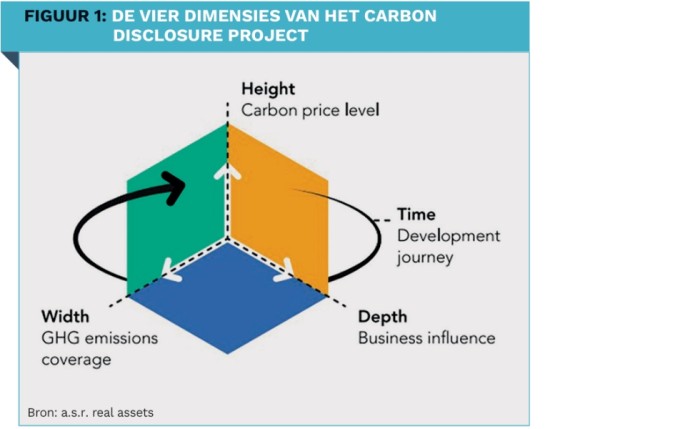
1) Height: what price level is required to achieve the climate targets?
Three methods are available for determining a price level: an organisation can use a market price (the price companies pay on the external CO₂ pricing market), a societal price (the societal costs of CO₂ emissions) and/or a prevention price (the costs a company incurs to meet climate targets). To obtain a transparent picture of the potential risk posed by CO₂ emissions to property, we apply the market price to all emissions falling within the CO₂ budget and the social price to all emissions outside the CO₂ budget.
2) Time: what price trend is required to achieve the climate targets?
The trend in the market price of CO₂ is determined by supply and demand, and will evolve further over time. Both the World Bank and CRREM provide forecasts of this trend, with CRREM focusing specifically on the property sector and the World Bank taking a more general approach. For the social and prevention prices, the trend over time is subject to inflation, as these are costs incurred by society or an organisation respectively.
For CO₂ emissions within the CO₂ budget, we follow the trend set out in the CRREM ICP Pathway. For emissions exceeding the CO₂ budget, the social price evolves in line with the ECB’s inflation target (2%) .
3) Scope: which emissions are covered by an ICP?
Buildings generate two types of emissions: material-related and operational. Material-related emissions are the CO₂ emissions arising from building materials and construction activities during the construction phase. Operational emissions are the CO₂ emissions resulting from energy consumption during the use phase. Currently, many organisations report only operational emissions, though there is growing interest in including material-related emissions in their reports as well. Both types of emissions are necessary to obtain a complete picture of a building’s impact on the climate.
We apply the internal CO₂ price to operational and material-related emissions, where data is available.
4) Scope: which investment decisions are covered by an ICP?
An ICP is relevant to decision-making on new investments, but may also be relevant in ongoing portfolio analyses and hold-sell analyses carried out by property asset managers. We apply the ICP in internal decision-making when selecting new investments and during the monitoring of existing investments.
From experiment to management tool
Practical experience shows that the application of an ICP involves uncertainties. For instance, the quality of data on CO₂ emissions is not always sufficient to enable consistent and comparable analyses. Furthermore, there is uncertainty regarding the correct price level, partly because market and policy developments are still evolving. There is also currently a lack of a standardised methodology, making it difficult to compare results between different parties.
With an ICP, CO₂ shifts from being an external constraint to a factor that plays a key role in shaping investment decisions
To further advance the application of an ICP, we are conducting a pilot for our direct property investments, based on the aforementioned principles, in which an ICP is incorporated as a shadow price into the expected returns. In practice, the application of an ICP may lead to lower expected returns for CO₂-intensive investments, and consequently to different investment decisions.
When selecting property funds, we do not view internal CO₂ pricing as a fixed instrument, but as a direction for development. The ICP requires market participants to make explicit trade-offs between economic rationality, responsibility and long-term impact. This reveals the extent to which transition risks are actually factored into portfolio decisions, and where this is not yet the case. We apply these insights in internal analyses, the selection of new investments and in our dialogue with fund managers. As a result, CO₂ is shifting from an external boundary condition to a factor that explicitly helps to shape investment decisions.
|
SUMMARY CO₂ emissions are becoming increasingly financially significant as transition risks are having a growing impact on returns and valuations. Traditional valuation models still take limited account of transition risks, resulting in the structural under-pricing of CO₂ risks. An internal CO₂ price makes transition risks explicit by assigning a monetary value to emissions and acts as a supplementary steering tool in investment decisions, alongside external CO₂ pricing. Despite uncertainties surrounding data, price levels and methodology, the internal CO₂ price is emerging as a relevant factor in selection, monitoring and engagement. The influence of the internal CO₂ price on selection, monitoring and engagement can be determined on the basis of four dimensions: level, time, scope and depth. |