
Webinar 'Impact & Green Bonds'
This article was originally written in Dutch. This is an English translation
The market for green bonds and impact bonds continues to evolve, but institutional investors are taking an increasingly critical view of impact claims and the actual contribution to sustainability goals. There is a growing realisation that genuine impact goes beyond simply investing in labelled bonds. That was one of the key conclusions drawn during a recent webinar.
By Esther Waal
|
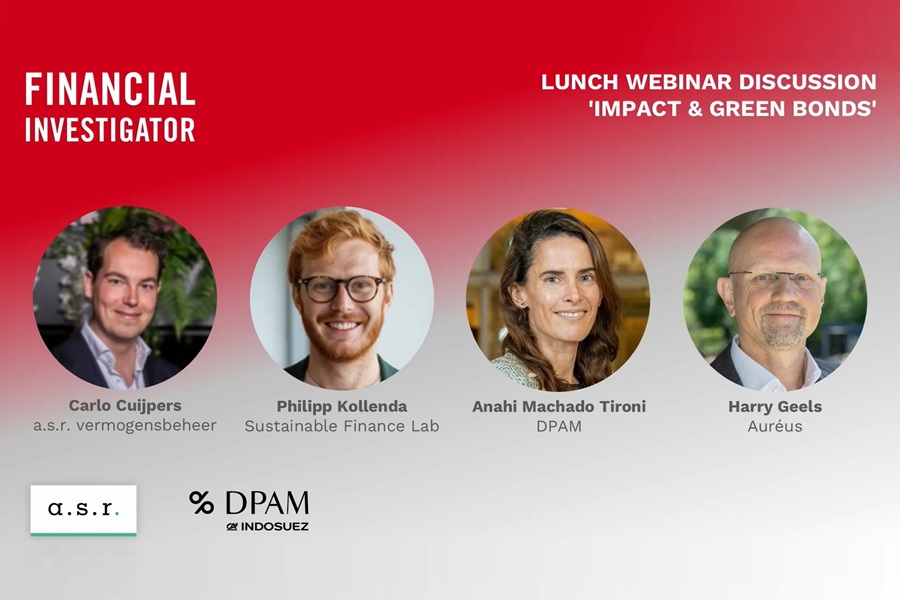
CHAIR Harry Geels, Senior Investment Advisor, Auréus
PARTICIPANTS Carlo Cuijpers, Responsible Investment Advisor, a.s.r. vermogensbeheer Philipp Kollenda, Researcher, Sustainable Finance Lab Anahi Machado Tironi, Fixed Income Portfolio Manager, DPAM |
Moderator Harry Geels begins the webinar by asking what exactly green bonds and impact bonds are. ‘Green bonds and impact bonds can be seen as umbrella terms for bonds whose proceeds are used for projects with a positive social impact,’ says Carlo Cuijpers of a.s.r. asset management.
According to Cuijpers, the growth of this segment of the investment universe has been impressive. ‘The market has grown to around six times its size since 2018.’ At the same time, he notes that the share of green bonds in new issuances has been declining slightly of late. Anahi Machado of DPAM concurs: ‘Green bonds now account for around 20 per cent of the European corporate bond market, but their share is levelling off. I would describe the market at present as one that is evolving from a phase of rapid expansion to a phase of greater maturity and credibility.’ According to her, this levelling off of growth does not mean that companies’ sustainability ambitions are waning. ‘The label may be becoming less prominent, but the ambition is still there and, in some cases, even stronger,’ says Machado. ‘Transition investments are increasingly being financed through conventional bonds.’
Impact: a debate over definitions
‘When is a green bond truly impact investing?’ asks Geels. Philipp Kollenda of Sustainable Finance Lab emphasises that green bonds are primarily about the input: ‘You specify how the investments are used and in what types of projects. But green bonds do not necessarily require you to specify what the ultimate impact of that investment is.’ In his view, it is often more about ‘alignment and disclosure’. That is why he believes it is important, in impact investing, to look not only at individual investments but at the entire portfolio. ‘Every investment has an impact, whether positive or negative. A portfolio-wide approach is important.’
Cuijpers shares this view and points out that whether a green bond is considered impact investing can vary from investor to investor. ‘There are parties that use a definition centred on “additionality”: does the financing genuinely enable extra impact?’ However, he believes this is difficult to determine. ‘For us, intentionality is the decisive factor: does the issuer genuinely wish to achieve a positive social impact?’ In his view, green bonds are a unique impact investing instrument. ‘They make it possible to raise large amounts of capital to achieve impact on a large scale, which is crucial, for example, to finance large-scale renewable energy projects and all the necessary investments in the surrounding infrastructure.’
Every investment has an impact, whether positive or negative. A portfolio-wide approach is important
According to Machado, in 2025, approximately 1.2 trillion dollars of energy transition investments were realised through debt financing, compared with just 77 billion via equities. ‘That underlines just how central fixed income is to financing the transition,’ says Machado. ‘Concrete examples include renewable energy, green buildings, electricity infrastructure and water management. However, we believe it is not enough for a project to be technically “green”. We assess green bonds based on the criteria of materiality, intentionality and additionality.’
According to Kollenda, green bonds are less suitable for sectors where technologies are not yet sufficiently mature. Venture capital-style solutions are needed there instead. He is even openly sceptical about biodiversity financing. ‘Within the bond market, we ultimately need a business case that can generate a financial return. And not all social or nature projects have that.’
Greenium disappears
It is striking that, according to the panellists, the so-called ‘greenium’ – the price premium on green bonds – has largely disappeared. ‘Issuers no longer benefit from a clear price premium,’ notes Machado. For investors, this has a twofold effect. On the one hand, it reduces the incentive for companies to issue green bonds specifically. On the other hand, it makes the choice easier for investors. ‘You don’t have to sacrifice returns to invest in green bonds,’ says Machado. In her view, green bonds should still be assessed first and foremost as regular bonds, based on credit quality, valuation and liquidity. ‘The label should complement the fundamental credit analysis, not replace it.’
For us, intentionality is the key factor: does the publisher genuinely wish to bring about a positive social impact?
Cuijpers also believes that green bonds should not be treated any differently from conventional bonds in financial terms. ‘The only difference is really that you also have to assess whether you endorse the impact case.’
Kollenda adds another point here: ‘The fact that green bonds are becoming increasingly similar to ordinary bonds in terms of pricing also means that, unless the financing costs for a green company are significantly lower, the impact resulting from a lower cost of capital is less prominent. That is why it is important to look at other benefits as well.’ Kollenda sees this benefit in the fact that green bonds force organisations to analyse their impact and report more transparently. ‘The whole process of measuring and reporting is, in itself, very important,’ he says.
Criticism of impact reporting
Nevertheless, a note of caution is also warranted here. According to Kollenda, some investors wrongly claim the full impact of projects, whilst they only provide part of the funding. ‘It is strange when multiple investors all report the total impact as part of their own portfolio,’ he says. In carbon credit markets in particular, he believes this can be detrimental to the market’s credibility.
If you focus solely on labelled bonds, you run the risk of missing out on a significant proportion of sustainable financing
Cuijpers recognises this issue. ‘When we recently drew up a report on the positive impact of our investments and used data from various data providers, at first glance it appeared we had achieved a huge impact. But on closer inspection, we saw significant overestimates of impact by green bond issuers.’ In his view, this problem really needs to be tackled, for example by the ICMA, but also by second-opinion providers and auditors. ‘Through thorough analysis, you can quickly see whether attribution is lacking.’
New phase
The conclusion is that green bonds have proven their worth as a financing instrument for the energy transition, but that the market has entered a new phase. Growth is continuing, but investors need to look beyond the label alone. As Machado sums it up: ‘If you only look at labelled bonds, you run the risk of missing out on a significant portion of sustainable financing.’
|
SUMMARY Green bonds and impact bonds have matured into a fully-fledged market, but investors are taking a more critical view of impact claims. Impact is not just about labels, but also about intentionality, additionality and portfolio-wide effects. Debt financing plays a key role in the energy transition. The ‘greenium’ has largely disappeared. Transparency and impact reporting remain important, but overestimating impact poses a risk. |
Read the full article in the digital edition of Financial Investigator magazine