
a.s.r. real assets: Nature credits in Dutch agriculture

This article was originally written in Dutch. This is an English translation
Interest in nature credits is growing. Governments, businesses and investors are looking for ways to turn biodiversity loss into restoration and to factor natural values into economic decision-making.
By Fadyan Pronk and Britt Elias
At the same time, the market is still in its infancy. There is a lack of uniform definitions, reliable measurement standards and a mature system of demand and price formation. The key question is therefore not how quickly nature credits can be traded, but what conditions are necessary to finance demonstrable biodiversity gains in a credible and sustainable manner.
Careful market development requires a phased approach. First, knowledge, measurability, governance and organisation must be in place. Thereafter, area-specific pilot schemes can demonstrate which approach works in practice. Tradable credits will only come into play once the ecological rationale, independent verification and market demand are sufficiently mature. Integrity must take precedence over speed.
Nature restoration as a financial issue
Nature credits are a relatively new instrument that links nature restoration to funding streams. The idea is simple: anyone who demonstrably contributes to biodiversity gains creates value that can be financed by public or private parties. In this way, natural values become more visible in economic decisions, for example in investment portfolios or sustainability strategies.
In practice, however, this promise is proving difficult to fulfil. Biodiversity is site-specific, complex and difficult to capture in a single, uniform measure. Whereas carbon credits focus on one metric tonne of CO₂, there is no equivalent for biodiversity. It is precisely for this reason that the integrity of measurement and reporting is central to all current discussions surrounding nature credits.
Why it is still too early for nature credits
Although public and policy attention is growing, the market for nature credits remains underdeveloped. There are several bottlenecks:
- No standardised units of measurement or certification frameworks.
- High transaction costs, particularly for smaller plots and individual farmers.
- Limited and volatile demand, with reputational risks for buyers.
- Governance regarding ownership, additionality and monitoring has not yet been sufficiently defined.
Consequently, there is a real risk that premature crediting could lead to claims that are difficult to verify or represent insufficient ecological value. For a long-term investor seeking to manage their portfolio responsibly and in a future-proof manner, this is a significant reason to exercise caution.
Credits are not offsets
There is a clear difference between nature credits and offsets. Offsets are intended to compensate for unavoidable damage, whereby negative effects are avoided or mitigated. Nature credits, on the other hand, are voluntary and aimed at achieving positive biodiversity gains.
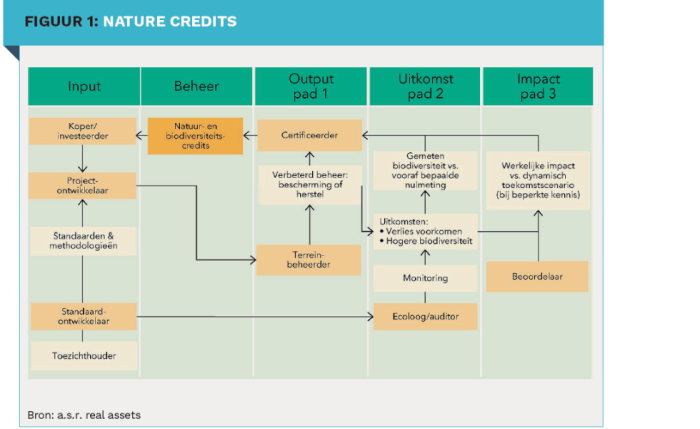
Nature credits in Dutch agriculture explicitly fall under this second category: they must contribute to a genuine improvement in the quality of nature on agricultural land and must not be used to justify biodiversity loss elsewhere. This requires transparency, due diligence and a clear definition of what is and is not rewarded. We also apply this principle to our own exploratory work and practical initiatives.
Practice on the farm
For farmers, biodiversity funding is only attractive if it is simple, reliable and scalable. Many individual initiatives falter due to administrative burdens, monitoring requirements or uncertainty about income.
What does work, however, is scaling up through an area-based approach. By bringing farmers together in collectives or landscape clusters, measurement costs can be shared and monitoring can be carried out more consistently.
Monitoring itself must remain robust yet practical: field observations where necessary, supplemented by digital techniques such as eDNA and remote sensing, always subject to independent verification.
It also appears that remuneration works best as part of a mix of financial incentives: grants, lease discounts, long-term management contracts and, in the long term, potentially income from nature credits.
Which initiatives are laying the necessary foundations?
Although tradable nature credits are still used to a limited extent in practice, various market players are working on the conditions needed to make this instrument credible in the future. Key building blocks include reliable data, area-specific collaboration, independent monitoring and a workable organisational framework for farmers. Our involvement in the Open Soil Index and Biodiversity Boosters demonstrates how such building blocks can be developed in practice.
Integrated Open Soil Index
The Open Soil Index (OBI) demonstrates how a consistent database can contribute to future-proof biodiversity financing. By systematically measuring soil quality and linking it to biodiversity and climate, a more coherent picture of ecological performance at farm and portfolio level emerges. This gives farmers greater insight and a clearer path to action, whilst enabling financiers and other stakeholders to make better comparisons and produce more effective reports. Within our farmland fund, we use this approach as a practical example of the measurement infrastructure required before credible crediting becomes possible.
Biodiversity Boosters
Biodiversity Boosters illustrates the importance of organisation and scale. The platform focuses on biodiversity projects, from intake and site demarcation to monitoring and verification. By clustering farmers regionally and working with a joint measurement and assurance methodology, transaction costs can be reduced and results tracked more consistently. We contribute to this initiative as a practical example of an infrastructure in which public funds, private contributions and, potentially in the long term, nature credits can complement one another.
A phased route to nature credits
Three successive phases are emerging for the broader development of the market:
- Measurability – Research, data collection and establishing indicators, with a focus on soil, biodiversity and integrated data platforms.
- Pilots – Implementing area-specific initiatives, with clear agreements on management, data, responsibilities and independent verification.
- Crediting – Only when standards, governance and market demand are sufficiently mature will tradable credits come into play.
Conclusion
Nature credits could, in the long term, be a valuable addition to the funding of biodiversity restoration in agriculture. However, their credibility stands or falls on reliable measurement methods, clear governance, additionality, independent verification and sufficient scale. That is why development must begin with ecological quality and a workable approach for farmers, not with the tradable product. Practical initiatives such as the OBI and Biodiversity Boosters help to build up experience with data, collaboration and monitoring. We, too, are investing in this through financial resources, expertise and our network. The broader lesson is that nature credits are not an end in themselves, but only gain value as the final piece in the jigsaw of demonstrable nature restoration.
|
IN SHORT Nature credits can make measurable improvements in biodiversity tradable. For farmers, transaction costs and scale are the biggest barriers. Market participants can contribute by linking knowledge, scale, long-term commitment and existing financing instruments. A phased approach to market development is required: first, measurability and pilot schemes, followed only then by potential crediting. Ecological integrity, independent verification and practicality for farmers ultimately determine the credibility of nature credits. |